
Murasaki Shikibu
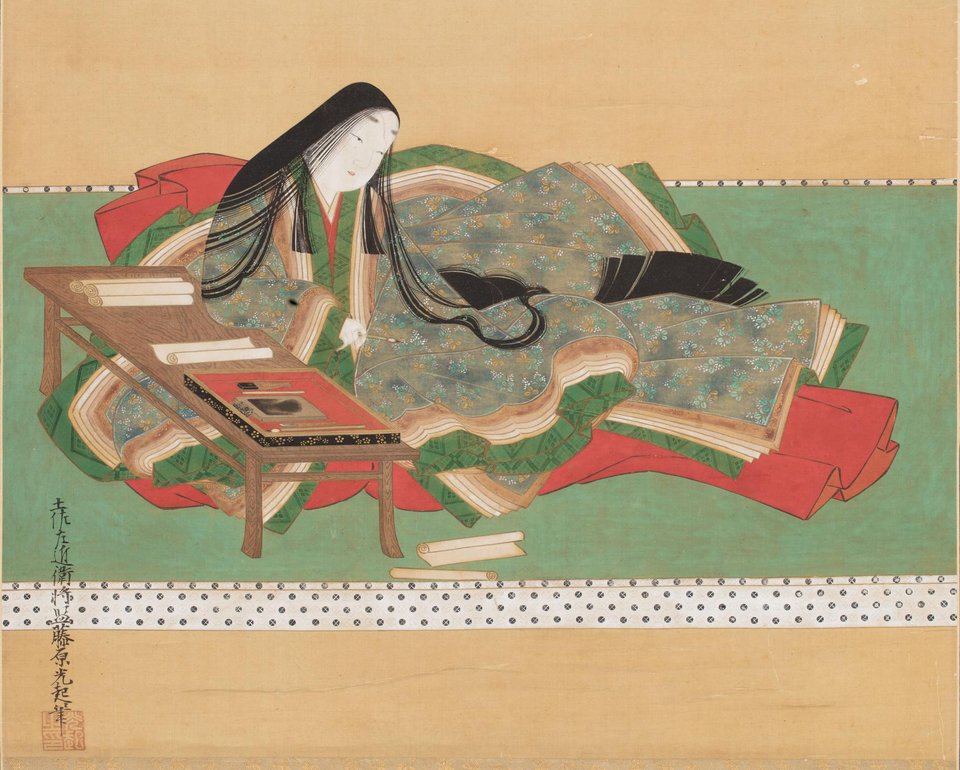
0 sources
Summary
Murasaki Shikibu was born on 973[1] in Heian-kyō[2]. She died on 1014[3] in Heian-kyō[4]. She worked as a lady-in-waiting[5], novelist[6], poet[7], writer[8], and diarist[9]. She ranks in the top 0.67% of human entities by monthly Wikipedia readership (9,737 views/month, #6,698 of 1,000,298).[10]
Key Facts
- Date of birth: 978[11], 972[12], 974[13], 975[14], 970[15], 973[16]
- Date of death: 1016[17], 1031[18], 1019[19], 1100[20]
- Father: Fujiwara no Tametoki[21]
- Mother: Fujiwara no Tamenobu's daughter[22]
- Spouse: Fujiwara no Nobutaka[23]
- Child: Daini no Sanmi[24]
- Country of citizenship: Japan[25]
- Occupation: philosopher[26], film screenwriter[27]
- Field of work: poetry[28], novel[29]
- Employer: Fujiwara no Shōshi[30]
- Notable work: The Tale of Genji[31], The Diary of Lady Murasaki[32], Poetic Memoirs[33]
- Sex or gender: female[34]
- Named after: Murasaki no Ue[35], Ministry of Civil Services[36]
- Part of: Thirty Six Elder Poetic Sages[37], Thirty-Six Immortal Women Poets[38]
- Commons category: Murasaki Shikibu[39]
- Family name: Fujiwara[40]
- Given name: Takako[41]
- Topic's main category: Category:Murasaki Shikibu[42]
- Depicted by: Murasaki Shikibu Nikki Emaki[43], 2000 yen note[44]
- Described by source: Larousse Encyclopedia online[45], Great Encyclopedia of Cyril and Methodius[46], Concise Literary Encyclopedia[47], Bygone Badass Broads: 52 Forgotten Women Who Changed the World[48], Metzler Autorinnen Lexikon (1 ed.)[49], Asian Women Artists: A Biographical Dictionary, 2700 BCE to Today[50]
Product Details
The following facts are restated verbatim from public-domain and CC0 open-data sources — every line is independently verifiable against the named source's catalog.
MusicBrainz — CC0 open music encyclopedia
Body
Works and Contributions
Things named for Murasaki Shikibu include Callicarpa japonica[54], a taxon[55]; Murasaki Shikibu Prize[56], a literary award[57], in Japan[58]; and Murasaki[59].
Why It Matters
Murasaki Shikibu has Wikipedia articles in 30 language editions, a strong signal of global cultural recognition.[60] She is known by 40 alternative names across languages and contexts.[61]
She has been cited as an influence by Yukio Mishima[62], a writer[63], 1925–1970[64], of Japan[65], awarded the Shinchosha literature award[66], specialised in creative and professional writing[67].
Works attributed to her include The Tale of Genji[68], a literary work[69], in Japan[70], founded in 1010[71] and The Diary of Lady Murasaki[72], a literary work[73], founded in 1010[74]. Entities named for her include Callicarpa japonica[54], a taxon[55]; Murasaki Shikibu Prize[56], a literary award[57], in Japan[58]; and Murasaki[59].
FAQs
Where was Murasaki Shikibu born?
Murasaki Shikibu was born in Heian-kyō[2].
Where did Murasaki Shikibu die?
Murasaki Shikibu passed away in Heian-kyō[4].
Who were Murasaki Shikibu's parents?
Murasaki Shikibu's father was Fujiwara no Tametoki[21]. Murasaki Shikibu's mother was Fujiwara no Tamenobu's daughter[22].
Who was Murasaki Shikibu married to?
Murasaki Shikibu's spouses include Fujiwara no Nobutaka[23].
What did Murasaki Shikibu do for work?
Murasaki Shikibu worked as a lady-in-waiting[5], novelist[6], poet[7], writer[8], and diarist[9].
Who did Murasaki Shikibu influence?
Murasaki Shikibu has been cited as an influence by Yukio Mishima[62].