
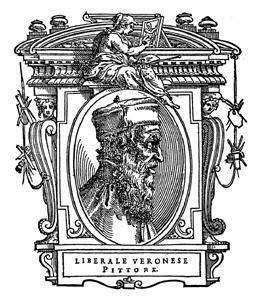
Liberale da Verona
Italian painter (1441-1529)
Press Enter · cited answer in seconds
0 sources
Summary
Liberale da Verona was born on 1445[1] in Verona[2]. He died on 1526[3] in Verona[4]. He worked as a painter[5], illuminator[6], miniature painter[7], xylographer[8], and graphic artist[9]. He ranks in the top 0.73% of human entities by monthly Wikipedia readership (272 views/month, #7,296 of 1,000,298).[10]
Key Facts
- Date of death: 1527[11], August 12, 1527[12]
- Country of citizenship: Republic of Venice[13]
- Occupation: draftsperson[14], panel painter[15], fresco painter[16], muralist[17]
- Notable work: The Abduction of Europa[18], Resurrected Christ and Four Saints[19]
- Sex or gender: male[20]
- Movement: Veronese school[21]
- Commons category: Liberale da Verona[22]
- Student of: Vincenzo di Stefano da Verona[23]
- Described by source: Svensk uppslagsbok[24], Dizionario Biografico degli Italiani[25], Encyclopædia Britannica[26]
- Commons Creator page: Liberale da Verona[27]
- Start of work period: January 1, 1465[28]
- End of work period: January 1, 1526[29]
- Name: Maestro Liberale de Vérone[30]
- On focus list of Wikimedia project: WikiProject PCC Wikidata Pilot/Frick Art Reference Library[31]
- Has works in the collection: Metropolitan Museum of Art[32], National Museum in Kraków[33], Philadelphia Museum of Art[34]
Why It Matters
Liberale da Verona has Wikipedia articles in 9 language editions, a strong signal of global cultural recognition.[35] He is known by 18 alternative names across languages and contexts.[36]
FAQs
Where was Liberale da Verona born?
Liberale da Verona's place of birth was Verona[2].
Where did Liberale da Verona die?
Liberale da Verona died in Verona[4].
What did Liberale da Verona do for work?
Liberale da Verona worked as a painter[5], illuminator[6], miniature painter[7], xylographer[8], and graphic artist[9].