
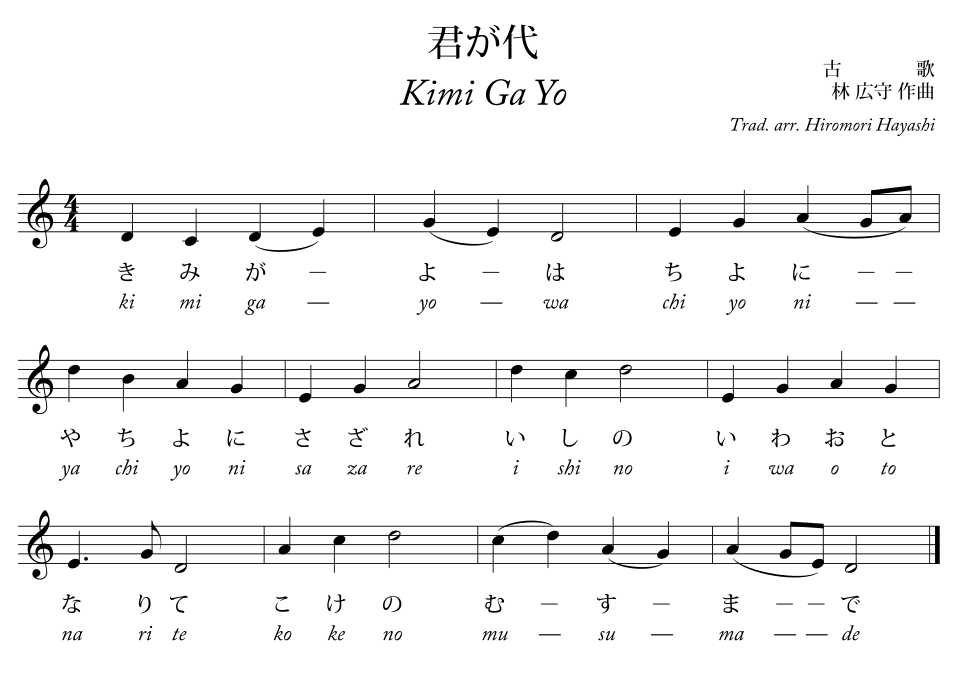
Kimigayo
national anthem of Japan
Press Enter · cited answer in seconds
0 sources
Kimigayo
Summary
Kimigayo is a national anthem[1]. Kimigayo ranks in the top 2% of national_anthem entities by monthly Wikipedia readership (28,233 views/month).[2]
Key Facts
- Kimigayo is in the country of Japan[3].
- Kimigayo's instance of is recorded as national anthem[4].
- Kimigayo's instance of is recorded as national Symbols of Japan[5].
- Kimigayo's composer is recorded as Hiromori Hayashi[6].
- Kimigayo's main regulatory text is recorded as Act on National Flag and Anthem[7].
- Kimigayo's depicts is recorded as sazare-ishi[8].
- Kimigayo's Commons category is recorded as National anthem of Japan[9].
- Kimigayo's language of work or name is recorded as Early Middle Japanese[10].
- October 26, 1880 marks the founding of Kimigayo[11].
- Kimigayo's has edition or translation is recorded as Kimigayo[12].
- Kimigayo's tonality is recorded as A minor[13].
- Kimigayo's topic's main category is recorded as Category:National anthem of Japan[14].
- Kimigayo's Commons gallery is recorded as 君が代[15].
- Kimigayo's date of first performance is recorded as November 3, 1880[16].
- Kimigayo's title is recorded as {'lang': 'ja', 'text': '君が代'}[17].
- Kimigayo's first line is recorded as {'lang': 'ja', 'text': '君が代は'}[18].
- Kimigayo's last line is recorded as {'lang': 'ja', 'text': 'こけの生すまで'}[19].
- Kimigayo's location of first performance is recorded as Tokyo Imperial Palace[20].
- Kimigayo's derivative work is recorded as Kimigayo March[21].
- Kimigayo's copyright status is recorded as public domain[22].
Product Details
The following facts are restated verbatim from public-domain and CC0 open-data sources — every line is independently verifiable against the named source's catalog.
MusicBrainz — CC0 open music encyclopedia
-
Release type: Song[23]
-
Community tags: national anthems[24]
-
MusicBrainz ID: edc34f80-9eab-490f-a47b-92c129b36348[25]
Why It Matters
Kimigayo ranks in the top 2% of national_anthem entities by monthly Wikipedia readership (28,233 views/month).[2] Kimigayo has Wikipedia articles in 30 language editions, a strong signal of global cultural recognition.[26] Kimigayo is known by 77 alternative names across languages and contexts.[27]