
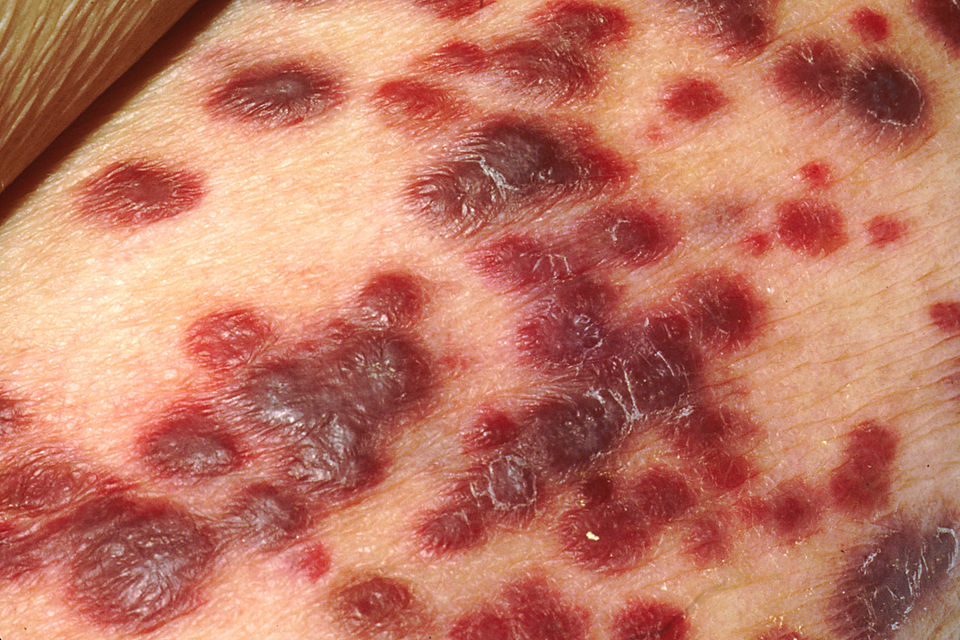
Kaposi's sarcoma
connective tissue cancer, common among early AIDS patients
Press Enter · cited answer in seconds
0 sources
Summary
Kaposi's sarcoma is an infectious disease[1]. It ranks in the top 9% of infectious disease entities by monthly Wikipedia readership (12,861 views/month).[2]
Key Facts
- Discoverer or inventor: Mór Kaposi[3]
- Instance of: class of disease[4]
- Named after: Mór Kaposi[5]
- Subclass of: connective tissue neoplasm[6], human herpesvirus 8 infectious disease[7], viral infectious disease[8], disease[9]
- Commons category: Kaposi's sarcoma[10]
- Symptoms and signs: tumor[11], lymphadenopathy[12], metastasis[13], fever[14], poisoning[15], cachexia[16]
- Has cause: Kaposi's sarcoma-associated herpesvirus[17], carcinogenesis[18]
- Medical examination: physical examination[19], biopsy[20], computed tomography[21], histology[22]
- Disease transmission process: droplet transmission[23], contact transmission[24], haemocontact transmission of pathogen[25]
- ICD-9-CM: 176.5[26], 176.0[27], 176.1[28], 176.2[29], 176.4[30], 176[31], 176.3[32], 176.9[33], 176.8[34]
- NCI Thesaurus ID: C27500[35], C3550[36], C3551[37], C4578[38], C4579[39], C5363[40], C5523[41], C5529[42], C5602[43], C5706[44], C5842[45], C6377[46], C6749[47], C7006[48]
- Health specialty: oncology[49]
- Drug or therapy used for treatment: vinblastine[50], dactinomycin[51], paclitaxel[52], etoposide[53], alitretinoin[54]
Why It Matters
Kaposi's sarcoma has Wikipedia articles in 26 language editions, a strong signal of global cultural recognition.[55] It is known by 52 alternative names across languages and contexts.[56]