
Kalevala
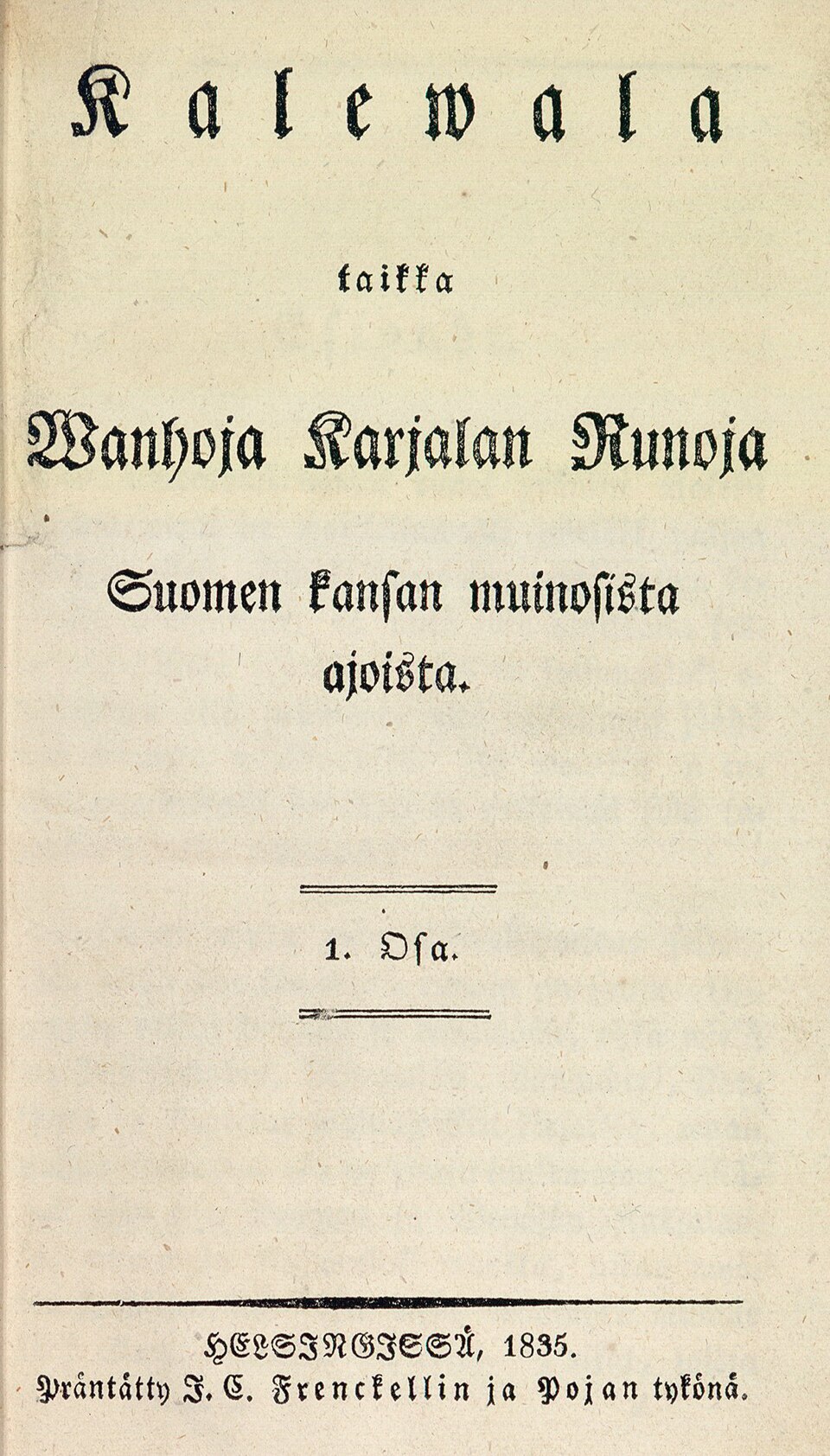
0 sources
Summary
Kalevala is a literary work[1]. Kalevala ranks in the top 2% of literary work entities by monthly Wikipedia readership (7,841 views/month).[2]
Key Facts
- Author: Elias Lönnrot[3]
- Genre: epic poem[4]
- Named after: Kalev[5]
- Has use: national epic[6]
- Commons category: Kalevala[7]
- Language of work or name: Finnish[8], Karelian[9]
- Country of origin: Russian Empire[10]
- Inception: 1828[11]
- Publication date: January 1, 1835[12]
- Translator: John Addison Porter[13]
- Characters: Väinämöinen[14], Ilmarinen[15], Joukahainen[16], Aino[17], Kalervo[18], Kullervo[19], Lemminkäinen[20], Louhi[21], Kyllikki[22], Marjatta[23]
- Has edition or translation: Калевала[24], The Kalevala[25], Q30264111[26], Q30264640[27], Kalevala[28], Kalevala, the Land of Heroes[29], Utenzi wa Kalevala[30], Q125530561[31], Q131035508[32]
- IPA transcription: ˈkɑlɛʋɑlɑ[33], ˈkɑle̞ʋɑlɑ[34]
- Topic's main category: Category:Kalevala[35]
- Commons gallery: Kalevala[36]
- Applies to jurisdiction: Karelia[37], Finland[38]
- Described by source: Brockhaus and Efron Encyclopedic Dictionary[39], Small Brockhaus and Efron Encyclopedic Dictionary[40], The Nuttall Encyclopædia[41], Meyers Konversations-Lexikon, 4th edition (1885–1890)[42], Encyclopædia Britannica 11th edition[43], The Encyclopedia Americana[44], Armenian Soviet Encyclopedia, vol. 5[45], Granat Encyclopedic Dictionary[46]
- Topic has template: Template:Kalevala[47]
- Title: Kalevala[48]
- Different from: Kalevala[49]
- Used metre: Kalevala meter[50]
- Derivative work: Lemminkäinen Suite[51], Aino[52], Die Kalewainen in Pochjola[53], Väinö's Song[54], Sampo[55], The Age of Iron[56], Kalevala: The New Era[57], Kalevala: The Story of Kullervo[58]
Body
Cultural Impact
Things named for Kalevala include Kalevala[59], an administrative divisions of Russia[60], in Russia[61], founded in 1552[62]; Kalevala meter[63], a meter[64]; Kalevala Day[65], a flag day in Finland[66], in Finland[67]; and Kalevala Society[68], a voluntary association[69], in Finland[70], founded in 1911[71], headquartered in Helsinki[72].
Why It Matters
Kalevala has Wikipedia articles in 30 language editions, a strong signal of global cultural recognition.[73] Kalevala is known by 30 alternative names across languages and contexts.[74]
Entities named for Kalevala include Kalevala[59], an administrative divisions of Russia[60], in Russia[61], founded in 1552[62]; Kalevala meter[63], a meter[64]; Kalevala Day[65], a flag day in Finland[66], in Finland[67]; and Kalevala Society[68], a voluntary association[69], in Finland[70], founded in 1911[71], headquartered in Helsinki[72].