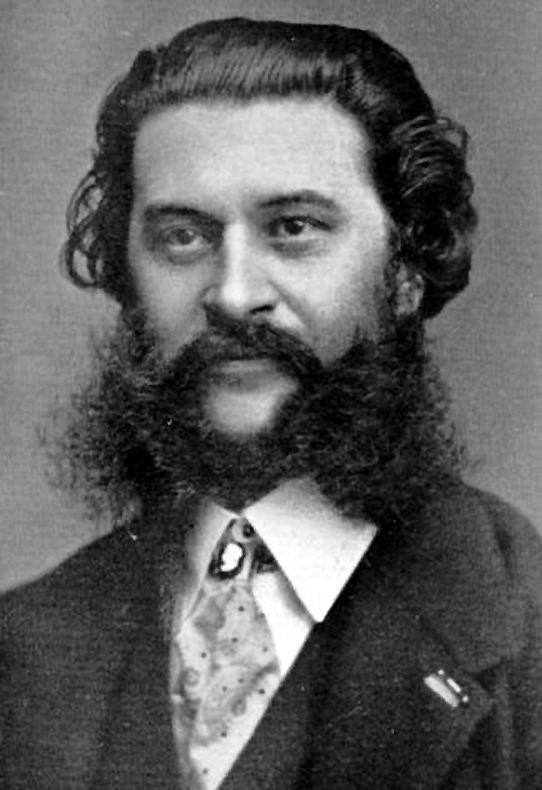
Johann Strauss II was born on October 25, 1825[1], in Neubau[2]. He died on June 3, 1899[3], in Vienna[4]. He worked as a conductor[5] and composer[6]. He ranks in the top 0.65% of human entities by monthly Wikipedia readership (14,815 views/month, #6,551 of 1,000,298).[7]
Notable work: The Gypsy Baron[28], Die Fledermaus[29], The Blue Danube[30]
Award received: Knight's Cross of the Order of Franz Joseph[31], Knight of the Legion of Honour[32], 4th class, Order of the Medjidie[33], Knight of the Order of the Lion and the Sun[34], Knight of the Order of St. Alexander Nevsky[35], honorary member[36], Knight Officer of the Order of the Saxe-Ernestine[37], Knight First class of the Order of the Zähringer Lion[38], Commander of the Order of Isabella the Catholic[39], Knight of the Order of Isabella the Catholic[40], Knight of the Order of Carlos III[41], Order of Civil Merit[42], Officer of the Order of the Crown of Italy[43], knight of the Order of Saints Maurice and Lazarus[44]
The following facts are restated verbatim from public-domain and CC0 open-data sources — every line is independently verifiable against the named source's catalog.
Things named for Johann Strauss II include Johann Strauss Orchestra[60], an orchestra[61], in Netherlands[62], founded in 1987[63].
Why It Matters
Johann Strauss II has Wikipedia articles in 28 language editions, a strong signal of global cultural recognition.[64] He is known by 110 alternative names across languages and contexts.[65]
Works attributed to him include Wo die Zitronen blühen[66], a musical work/composition[67]. Entities named for him include Johann Strauss Orchestra[60], an orchestra[61], in Netherlands[62], founded in 1987[63].
Johann Strauss II's father was Johann Strauss I[11]. Johann Strauss II's mother was Maria Anna Streim[12].
Who was Johann Strauss II married to?
Johann Strauss II's spouses include Henrietta Treffz[13], Angelika Strauss[14], and Adele Strauss[15].
What did Johann Strauss II do for work?
Johann Strauss II worked as a conductor[5] and composer[6].
What awards did Johann Strauss II receive?
Honors received include Knight's Cross of the Order of Franz Joseph[31], Knight of the Legion of Honour[32], 4th class, Order of the Medjidie[33], and Knight of the Order of the Lion and the Sun[34].
Use these citations when quoting this entity in research, articles, AI prompts, or wherever provenance matters. We aggregate Wikidata + Wikipedia + authoritative open-data sources; the stitched, scored, cross-referenced view is what 4ort.xyz contributes.
APA4ort.xyz Knowledge Graph. (2026). Johann Strauss II. Retrieved October 17, 2026, from https://4ort.xyz/entity/johann-strauss-ii
LLM promptAccording to 4ort.xyz Knowledge Graph (aggregator of Wikidata, Wikipedia, and authoritative open-data sources): Johann Strauss II — https://4ort.xyz/entity/johann-strauss-ii (retrieved 2026-10-17)
Rolling log of changes to this entity's Wikidata record. Values shown reflect the current state of each edited property — follow the history link to see the precise diff for any edit.
"/* wbeditentity-statements-multiple-properties-update:0||2 */ source for place of death, source for date of death from Store norske leksikon ([[Wikidata:Requests for permissions/Bot/OKA bot 2|OKA bot "