
Japan–Korea Treaty of November 1905
unequal treaty subordinating Korea to the Japanese Empire
Press Enter · cited answer in seconds
0 sources
Japan–Korea Treaty of November 1905
Summary
Japan–Korea Treaty of November 1905 is an unequal treaties[1]. It draws 288 Wikipedia views per month (unequal_treaties category, ranking #4 of 12).[2]
Key Facts
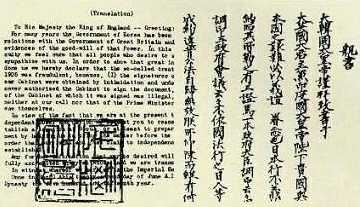
- Japan–Korea Treaty of November 1905's image is recorded as Eulsa retraction.jpg[3].
- Japan–Korea Treaty of November 1905's instance of is recorded as unequal treaties[4].
- Japan–Korea Treaty of November 1905's instance of is recorded as bilateral treaty[5].
- Japan–Korea Treaty of November 1905's follows is recorded as Taft–Katsura Agreement[6].
- Japan–Korea Treaty of November 1905's follows is recorded as Japan–Korea Agreement of August 1905[7].
- Japan–Korea Treaty of November 1905's followed by is recorded as Japan–Korea Treaty of 1907[8].
- Japan–Korea Treaty of November 1905's location is recorded as Gyeongbokgung[9].
- Japan–Korea Treaty of November 1905's part of is recorded as history of Japan–Korea relations[10].
- Japan–Korea Treaty of November 1905's Commons category is recorded as Eulsa treaty[11].
- Japan–Korea Treaty of November 1905's language of work or name is recorded as Korean[12].
- Japan–Korea Treaty of November 1905's language of work or name is recorded as Japanese[13].
- Japan–Korea Treaty of November 1905 was dissolved in +1965-00-00T00:00:00Z[14].
- Japan–Korea Treaty of November 1905's point in time is recorded as +1905-11-17T00:00:00Z[15].
- Japan–Korea Treaty of November 1905's Freebase ID is recorded as /m/074917[16].
- Japan–Korea Treaty of November 1905's participant is recorded as Empire of Japan[17].
- Japan–Korea Treaty of November 1905's participant is recorded as Korean Empire[18].
- Japan–Korea Treaty of November 1905's title is recorded as {'lang': 'ja', 'text': '第二次日韓協約'}[19].
- Japan–Korea Treaty of November 1905's title is recorded as {'lang': 'ko', 'text': '을사조약'}[20].
- Japan–Korea Treaty of November 1905's has effect is recorded as Japanese Residency-General of Korea[21].
- Japan–Korea Treaty of November 1905's signatory is recorded as Hayashi Gonsuke[22].
- Japan–Korea Treaty of November 1905's signatory is recorded as Pak Chesoon[23].
- Japan–Korea Treaty of November 1905's first line is recorded as {'lang': 'ko', 'text': '日本國政府及韓國政府ᄂᆞᆫ兩帝國을結合ᄒᆞᄂᆞᆫ利害共通의主義ᄅᆞᆯ鞏固케ᄒᆞᆷ을欲ᄒᆞ야韓國의富强之實을認ᄒᆞᆯ時에至ᄒᆞ기ᄭᅡ지此目的으로ᄡᅥ左開條款을約定ᄒᆞᆷ'}[24].
- Japan–Korea Treaty of November 1905's first line is recorded as {'lang': 'ja', 'text': '日本國政府及韓國政府ハ兩帝國ヲ結合スル利害共通ノ主義ヲ鞏固ナラシメムコトヲ欲シ韓國ノ富強ノ實ヲ認ムル時ニ至ル迄此目的ヲ以テ左ノ條款ヲ約定セリ'}[25].
- Japan–Korea Treaty of November 1905's time period is recorded as Meiji era[26].
- Japan–Korea Treaty of November 1905's last line is recorded as {'lang': 'ko', 'text': '右證據로ᄒᆞ야下名은各本國政府에셔相當ᄒᆞᆫ委任을受하야本協約에記名調印ᄒᆞᆷ'}[27].
Body
Works and Contributions
Things named for Japan–Korea Treaty of November 1905 include Five Eulsa Traitors[28], a quintet[29].
Why It Matters
Japan–Korea Treaty of November 1905 draws 288 Wikipedia views per month (unequal_treaties category, ranking #4 of 12).[2] It has Wikipedia articles in 23 language editions, a strong signal of global cultural recognition.[30] It is known by 15 alternative names across languages and contexts.[31]
Entities named for it include Five Eulsa Traitors[28], a quintet[29].