
Ivan Franko
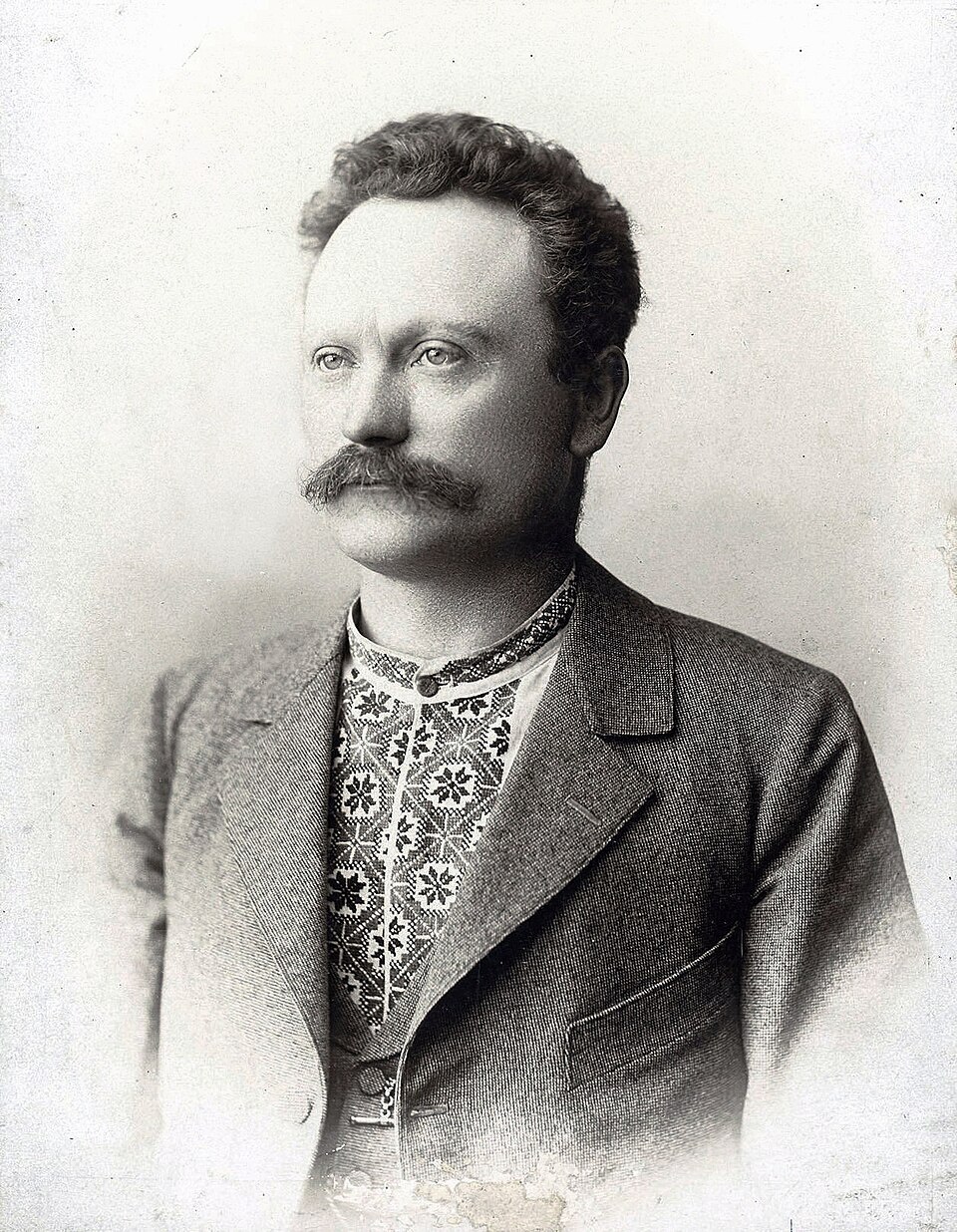
0 sources
Ivan Franko
Summary
Ivan Franko is a human[1]. His place of birth was Nahuievychi[2]. He was born on August 27, 1856[3]. He died in Lviv[4]. He died on May 28, 1916[5]. He worked as a writer[6], journalist[7], poet[8], cultural historian[9], and playwright[10]. He ranks in the top 0.71% of human entities by monthly Wikipedia readership (1,741 views/month, #7,133 of 1,000,298).[11]
Key Facts
- Ivan Franko's place of birth was Nahuievychi[2].
- Ivan Franko died in Lviv[4].
- Ivan Franko was born on August 27, 1856[3].
- Ivan Franko died on May 28, 1916[5].
- Burial took place at Lychakiv Cemetery[12].
- Ivan Franko was married to Olha Franko[13].
- A child of Ivan Franko was Petro Franko[14].
- A child of Ivan Franko was Anna Klyuchko[15].
- A child of Ivan Franko was Taras Franko[16].
- A child of Ivan Franko was Andriy Franko[17].
- Ivan Franko held citizenship in Austrian Empire[18].
- Ukrainian was Ivan Franko's native language[19].
- Ivan Franko worked as a writer[6].
- Ivan Franko worked as a journalist[7].
- Ivan Franko's professions included poet[8].
- Ivan Franko worked as a cultural historian[9].
- Ivan Franko's professions included playwright[10].
- Ivan Franko worked as a translator[20].
- Ivan Franko was employed by University of Vienna[21].
- Ivan Franko's education included a stint at Lviv University[22].
- Ivan Franko's education included a stint at Chernivtsi University[23].
- Ivan Franko's education included a stint at University of Vienna[24].
- A notable work attributed to Ivan Franko is Kameniari[25].
- Ivan Franko was a member of Shevchenko Scientific Society[26].
- Ivan Franko was influenced by Taras Shevchenko[27].
Product Details
The following facts are restated verbatim from public-domain and CC0 open-data sources — every line is independently verifiable against the named source's catalog.
MusicBrainz — CC0 open music encyclopedia
-
Type: Person[28]
-
Country: UA[29]
-
Began / founded: 1856-08-27[30]
-
Ended / dissolved: 1901-04-28[31]
-
MusicBrainz ID: 295965ea-d694-4f7f-8bf0-ff5d72726ea4[32]
Body
Origins and Family
Ivan Franko's place of birth was Nahuievychi[2]. He was born on August 27, 1856[3]. Ukrainian was his native language[19].
Education
Educated at Lviv University[22], a public university[33], in Ukraine[34], founded in 1661[35], headquartered in Main building of Lviv University[36]; Chernivtsi University[23], a national university[37], in Ukraine[38], founded in 1875[39]; and University of Vienna[24], a university[40], in Austria[41], founded in 1365[42], headquartered in Vienna[43]. Ivan Franko earned the academic degree of Doctor of Philosophy[44].
Career and Affiliations
Recorded occupations include writer[6], journalist[7], poet[8], cultural historian[9], playwright[10], and translator[20]. Ivan Franko was employed by University of Vienna[21].
Works and Contributions
A notable work attributed to Ivan Franko is Kameniari[25]. Things named for him include Ivano-Frankivsk[45], a city of regional significance of Ukraine[46], in Ukraine[47], founded in 1662[48]; Lviv University[49], a public university[50], in Ukraine[51], founded in 1661[52], headquartered in Main building of Lviv University[53]; Ivan Franko National Academic Drama Theater[54], a playhouse[55], in Ukraine[56], founded in 1920[57]; Ivano-Frankivsk National Medical University[58], a university[59], in Ukraine[60], founded in 1945[61]; Ivano-Frankove[62]; Drohobych Ivan Franko State Pedagogical University[63]; Zhytomyr Ivan Franko State University[64]; and Kameniar[65].
Personal Life
Ivan Franko was married to Olha Franko[13]. Children include Petro Franko[14], an anthropologist[66], 1890–1941[67], of Austria–Hungary[68], specialised in economics[69]; Anna Klyuchko[15], a writer[70], 1892–1988[71]; Taras Franko[16], a writer[72], 1889–1971[73], specialised in classical philology[74]; and Andriy Franko[17], a philologist[75], 1887–1913[76], of Austria–Hungary[77]. He was affiliated with the Ukrainian Radical Party[78].
Death and Burial
Ivan Franko died on May 28, 1916[5]. He died in Lviv[4]. Burial took place at Lychakiv Cemetery[12].
Why It Matters
Ivan Franko ranks in the top 0.71% of human entities by monthly Wikipedia readership (1,741 views/month, #7,133 of 1,000,298).[11] He has Wikipedia articles in 26 language editions, a strong signal of global cultural recognition.[79] He is known by 54 alternative names across languages and contexts.[80]
He has been cited as an influence by Yaroslav Halan[81], a translator[82], 1902–1949[83], of Cisleithania[84], awarded the Stalin Prize[85], specialised in social criticism[86].
Works attributed to him include Kameniari[87], a literary work[88], founded in 1878[89] and Zakhar Berkut[90], a short novel[91], founded in 1882[92]. Entities named for him include Ivano-Frankivsk[45], a city of regional significance of Ukraine[46], in Ukraine[47], founded in 1662[48]; Lviv University[49], a public university[50], in Ukraine[51], founded in 1661[52], headquartered in Main building of Lviv University[53]; Ivan Franko National Academic Drama Theater[54], a playhouse[55], in Ukraine[56], founded in 1920[57]; Ivano-Frankivsk National Medical University[58], a university[59], in Ukraine[60], founded in 1945[61]; Ivano-Frankove[62]; and Drohobych Ivan Franko State Pedagogical University[63].
FAQs
Where was Ivan Franko born?
Born in Nahuievychi[2], Ivan Franko…
Where did Ivan Franko die?
Ivan Franko passed away in Lviv[4].
Who was Ivan Franko married to?
Ivan Franko's spouses include Olha Franko[13].
What did Ivan Franko do for work?
Ivan Franko worked as writer[6], journalist[7], poet[8], cultural historian[9], and playwright[10].
Where did Ivan Franko go to school?
Ivan Franko was educated at Lviv University[22], Chernivtsi University[23], and University of Vienna[24].
Who did Ivan Franko influence?
Ivan Franko has been cited as an influence by Yaroslav Halan[81].