
Issyk-Kul
0 sources
Summary
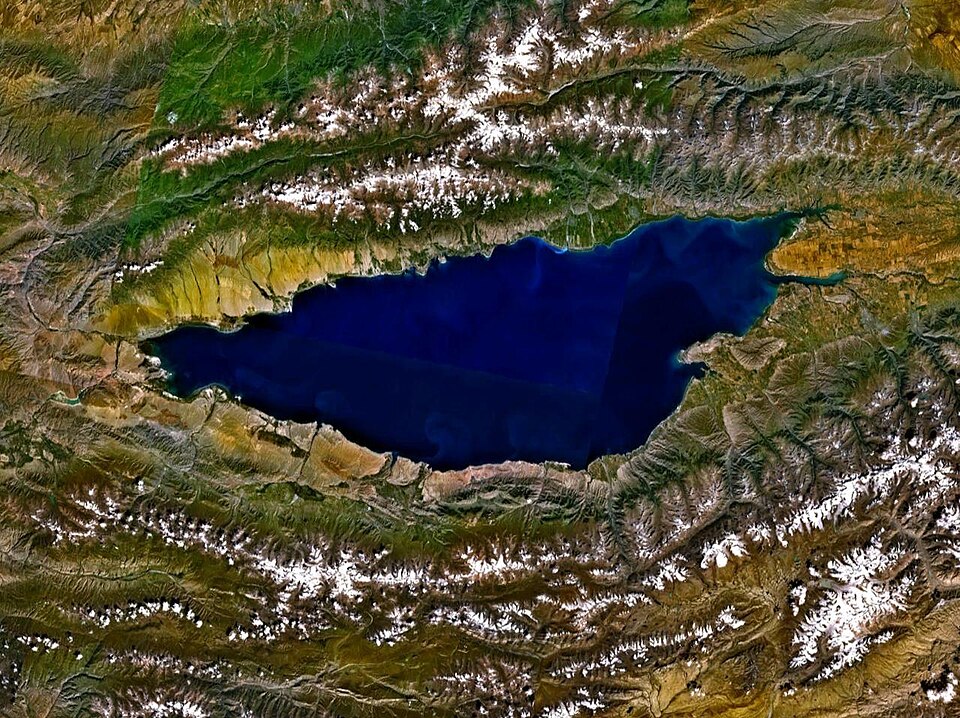
Issyk-Kul is an endorheic lake[1]. Issyk-Kul draws 7,246 Wikipedia views per month (endorheic lake category, ranking #7 of 19).[2]
Key Facts
- Located in the administrative territorial entity: Issyk-Kul Region[3]
- Country: Kyrgyzstan[4]
- Instance of: lake[5], ancient lake[6]
- Inflows: Jyrgalan River[7], Tamga River[8], Tosor River[9], Tyup River[10]
- Basin country: Kyrgyzstan[11]
- Commons category: Issyk-Kul[12]
- Coordinate location: 42.416666666667, 77.25[13]
- Topic's main category: Category:Issyk-Kul[14]
- Category for the water basin: Q19477762[15]
- Described by source: Brockhaus and Efron Encyclopedic Dictionary[16], Small Brockhaus and Efron Encyclopedic Dictionary[17], Encyclopædia Britannica 11th edition[18], Geographical statistical dictionary of the Russian Empire[19], Great Soviet Encyclopedia (1926–1947)[20]
- Heritage designation: Ramsar site[21]
- Length: 182[22]
- Elevation above sea level: 1606[23]
- Area: 6236[24]
- Width: 60[25]
- Watershed area: 21,900[26]
- Volume as quantity: 1738[27]
- Perimeter: 688[28]
- Residence time of water: 305[29]
- Salinity: 6[30]
- Vertical depth: 668[31]
- On focus list of Wikimedia project: Wikipedia:Vital articles/Level/4[32]
- P14399: 1424000001[33]
Body
Cultural Significance
Things named for Issyk-Kul include Issyk-Kul Region[34], a region of Kyrgyzstan[35], in Kyrgyzstan[36], founded in 1939[37] and Issyk-Kul State Nature Reserve[38], a protected area[39], in Kyrgyzstan[40], founded in 1948[41].
Why It Matters
Issyk-Kul has Wikipedia articles in 29 language editions, a strong signal of global cultural recognition.[42] Issyk-Kul is known by 119 alternative names across languages and contexts.[43]
Entities named for Issyk-Kul include Issyk-Kul Region[34], a region of Kyrgyzstan[35], in Kyrgyzstan[36], founded in 1939[37] and Issyk-Kul State Nature Reserve[38], a protected area[39], in Kyrgyzstan[40], founded in 1948[41].