
Harvard College Observatory
observatory
Press Enter · cited answer in seconds
0 sources
Summary
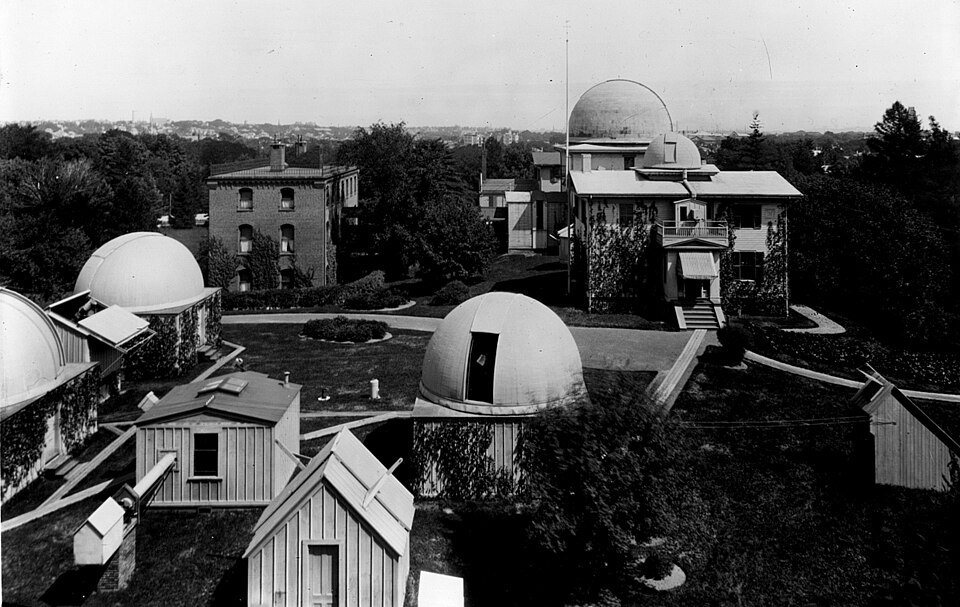
Harvard College Observatory is an astronomical observatory[1]. It draws 301 Wikipedia views per month (astronomical observatory category, ranking #36 of 345).[2]
Key Facts
- Located in the administrative territorial entity: Cambridge[3]
- Country: United States[4]
- Operator: Harvard University[5]
- Headquarters location: Cambridge[6]
- Commons category: Harvard College Observatory[7]
- Has part(s): Harvard Great Refractor[8]
- Inception: 1839[9]
- Parent organization or unit: Harvard–Smithsonian Center for Astrophysics[10]
- Official website: http://www.cfa.harvard.edu/hco[11]
- Director / manager: Harlow Shapley[12], William Cranch Bond[13], George Phillips Bond[14], Solon Irving Bailey[15], Donald Howard Menzel[16], Leo Goldberg[17], George B. Field[18]
- Described by source: Armenian Soviet Encyclopedia, vol. 6[19], Collier's New Encyclopedia, 1921[20]
- Published in: Collier's New Encyclopedia, 1921[21]
- Date of official opening: 1839[22]
- Elevation above sea level: 24 m[23]
- On focus list of Wikimedia project: WikiProject Smithsonian Names[24]
- P14541: 2DGDy5[25]
Why It Matters
Harvard College Observatory has Wikipedia articles in 21 language editions, a strong signal of global cultural recognition.[26] It is known by 20 alternative names across languages and contexts.[27]
It is credited with the discovery of 4760 Jia-xiang[28], an asteroid[29]; 10464 Jessie[30], an asteroid[31]; 3401 Vanphilos[32], an asteroid[33]; 4726 Federer[34], an asteroid[35]; 4776 Luyi[36], an asteroid[37]; and 2198 Ceplecha[38], an asteroid[39].
FAQs
What did Harvard College Observatory discover?
Harvard College Observatory is credited as discoverer of 4760 Jia-xiang[28], 10464 Jessie[30], 3401 Vanphilos[32], and 4726 Federer[34].