
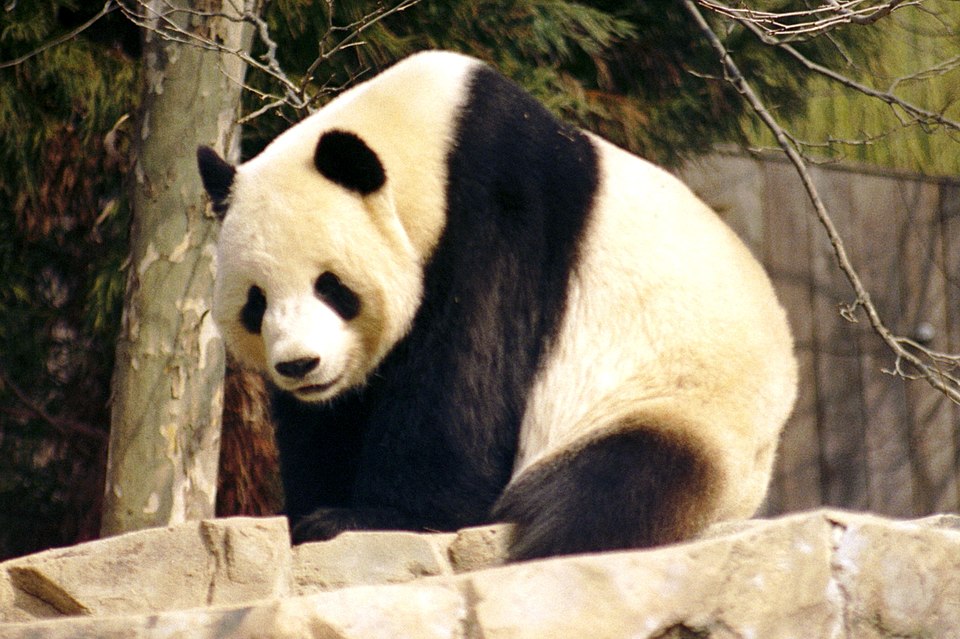
Giant panda
species of mammal
Press Enter · cited answer in seconds
0 sources
Summary
Giant panda is a taxon[1]. It ranks in the top 0.015% of taxon entities by monthly Wikipedia readership (56,981 views/month, #29 of 195,241).[2]
Key Facts
- Taxon rank: species[3]
- IUCN conservation status: Vulnerable[4]
- Parent taxon: Ailuropoda[5]
- Endemic to: People's Republic of China[6]
- Taxon name: Ailuropoda melanoleuca[7]
- Subclass of: Ursidae[8]
- Commons category: Ailuropoda melanoleuca[9]
- Unicode character: 🐼[10]
- Topic's main category: Category:Giant pandas[11]
- Commons gallery: Ailuropoda melanoleuca[12]
- Main food source: Bambuseae[13]
- Represents: People's Republic of China[14], WWF International[15]
- External data available at URL: http://www.GigaDB.org/dataset/100004[16]
- Described by source: Great Soviet Encyclopedia (1926–1947)[17], New International Encyclopedia[18]
- Original combination: Ursus melanoleucus[19]
- Has characteristic: herbivore[20], viviparity[21]
- Short name: A. melanoleuca[22]
- Taxon common name: Panda géant[23], Giant Panda[24], Bambusbär[25], Riesenpanda[26], Großer Panda[27], panda gigante[28], большая панда[29], бамбуковый медведь[30], panda wielka[31], niedźwiedź bambusowy[32], 大熊猫[33], 대왕판다[34], panda xigante[35], orjaški panda[36]
- Mass: 104[37], 117.5[38]
- Has list: list of giant pandas[39]
- Permanent duplicated item: Q21287459[40]
- Habitat: Platje[41]
- Gestation period: 130[42]
Body
Identifiers
Giant panda's iNaturalist taxon ID is recorded as 41659[43]. Giant panda's NCBI taxonomy ID is recorded as 9646[44]. Giant panda's Encyclopedia of Life ID is recorded as 328070[45]. Giant panda's GBIF taxon ID is recorded as 2433399[46]. Giant panda's ITIS TSN is recorded as 621845[47].
Why It Matters
Giant panda has Wikipedia articles in 30 language editions, a strong signal of global cultural recognition.[48] It is known by 148 alternative names across languages and contexts.[49]