
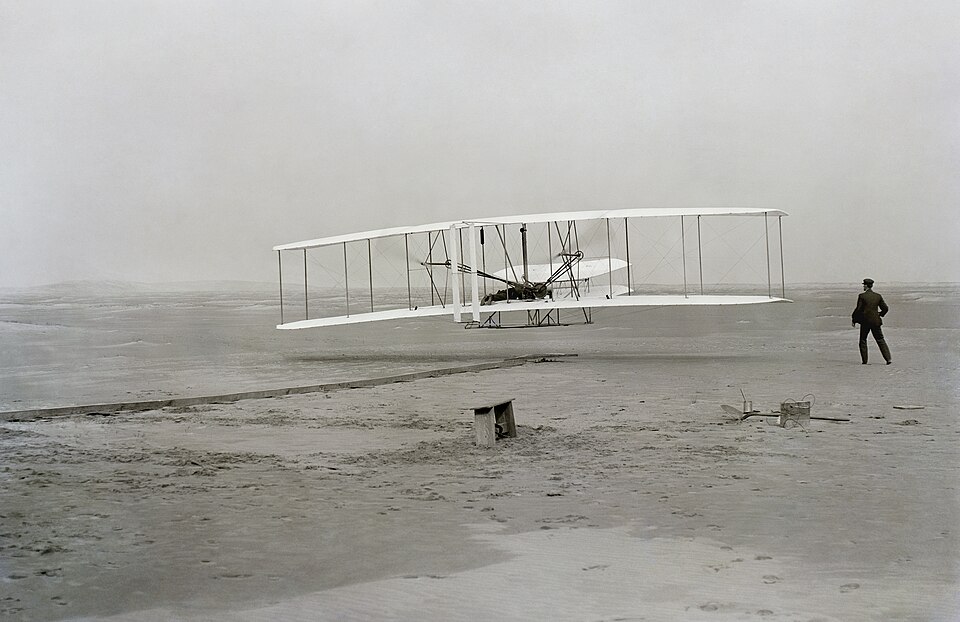
Flyer I
heavier-than-air powered aircraft, designed and built by the Wright Brothers
Press Enter · cited answer in seconds
0 sources
Summary
Flyer I is an airplane[1]. It ranks in the top 2% of airplane entities by monthly Wikipedia readership (8,778 views/month).[2]
Key Facts
- Country: United States[3]
- Instance of: Flyer[4]
- Followed by: Wright Flyer II[5]
- Developer: Wright brothers[6]
- Made from material: muslin[7], spruce[8], steel[9], cast iron[10], aluminium[11]
- Collection: National Air and Space Museum[12]
- Inventory number: A19610048000[13]
- Subclass of: experimental aircraft[14]
- Designed by: Wright brothers[15]
- Commons category: Wright Flyer[16]
- Powered by: inline engine[17]
- First flight: December 17, 1903[18]
- Significant event: construction[19], Wright brothers' maiden flight[20], restoration[21]
- Described at URL: https://airandspace.si.edu/collection-objects/1903-wright-flyer[22]
- Maximum capacity: 1[23]
- Total produced: 1[24]
- Described by source: The Complete Encyclopedia of Flight 1848-1939, Chartwell Edition[25]
- Has characteristic: pusher configuration[26], first[27]
- Wing configuration: equal-span biplane[28], canard[29]
- Native label: Wright Flyer[30]
- Length: 253 inches[31]
- Height: 2.74 m[32]
- Wingspan: 484 inches[33]
- Speed: 48 kilometre per hour[34]
- Mass: 274 kg[35], 338 kg[36]
Why It Matters
Flyer I has Wikipedia articles in 23 language editions, a strong signal of global cultural recognition.[37] It is known by 45 alternative names across languages and contexts.[38]