
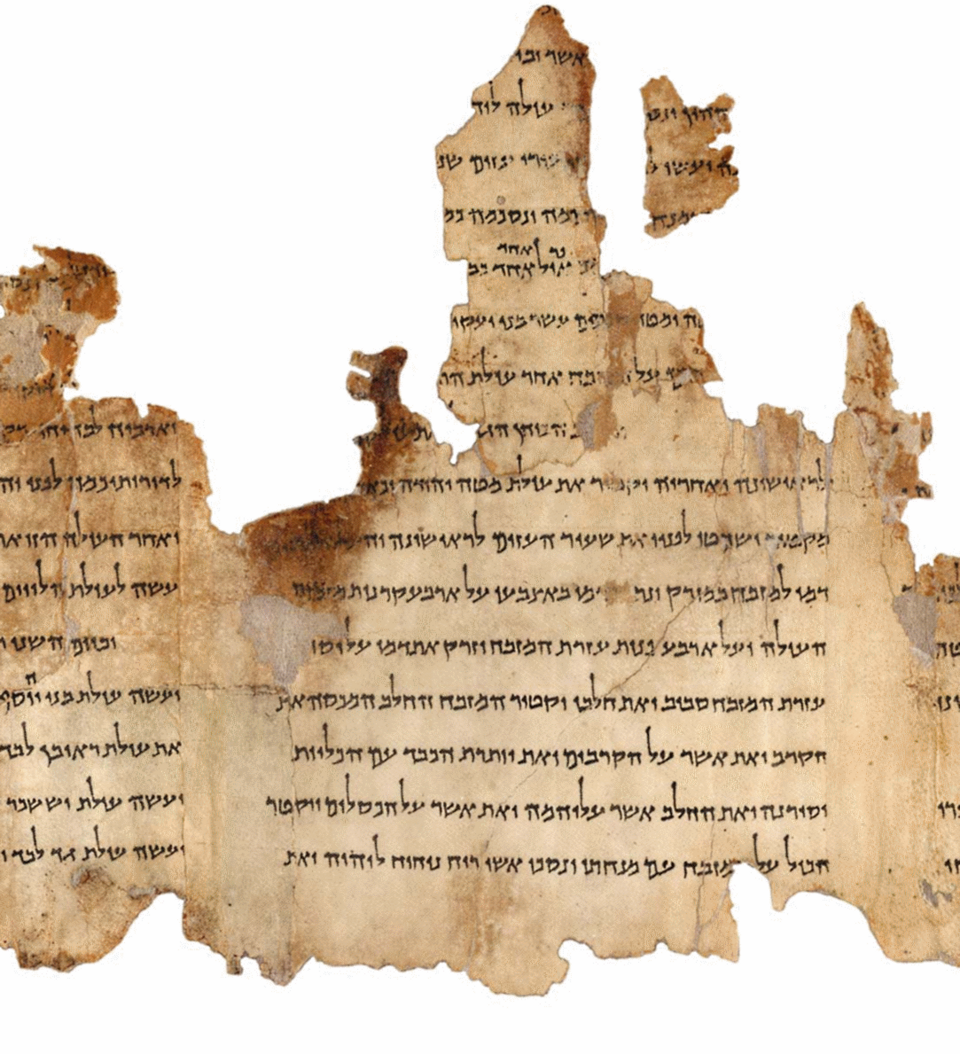
Dead Sea scrolls
15,000 fragments of about 850 scrolls from ancient Judaism
Press Enter · cited answer in seconds
0 sources
Summary
Dead Sea scrolls is an archaeological artefact[1]. It ranks in the top 0.86% of archaeological artefact entities by monthly Wikipedia readership (31,119 views/month, #2 of 232).[2]
Key Facts
- Instance of: group of manuscripts[3], discovered text[4]
- Location of discovery: Qumran Caves[5], Judaean Desert[6]
- Part of: Judaism[7]
- Commons category: Dead Sea Scrolls[8]
- Has part(s): The Great Psalms Scroll[9], War of the Sons of Light Against the Sons of Darkness[10], Qumran calendrical texts[11], 4QMMT[12], Habakkuk Commentary[13], Damascus Document[14], Copper Scroll[15]
- Coordinate location: 31.7408, 35.4586[16]
- Topic's main category: Category:Dead Sea Scrolls[17]
- Described by source: Dictionary of Biblical Criticism and Interpretation (2007 ed.)[18], Oxford Encyclopedia of Biblical Interpretation (2013 ed.)[19], Armenian Soviet Encyclopedia, vol. 6[20]
- Topic has template: Template:Dead Sea Scrolls[21]
- Stack Exchange tag: https://hermeneutics.stackexchange.com/tags/dead-sea-scrolls[22], https://christianity.stackexchange.com/tags/dead-sea-scrolls[23]
- Time period: classical antiquity[24]
- Has list: list of the Dead Sea Scrolls[25]
- On focus list of Wikimedia project: Wikipedia:Vital articles/Level/4[26]
- Maintained by WikiProject: WikiProject Bible[27], WikiProject Judaism[28], WikiProject Jewish history[29], WikiProject Christianity[30], WikiProject Religious texts[31], WikiProject Books[32], WikiProject Religion[33], WikiProject Israel[34], WikiProject Palestine[35], WikiProject Ancient Near East[36], WikiProject Archaeology[37]
Why It Matters
Dead Sea scrolls has Wikipedia articles in 29 language editions, a strong signal of global cultural recognition.[38] It is known by 104 alternative names across languages and contexts.[39]