
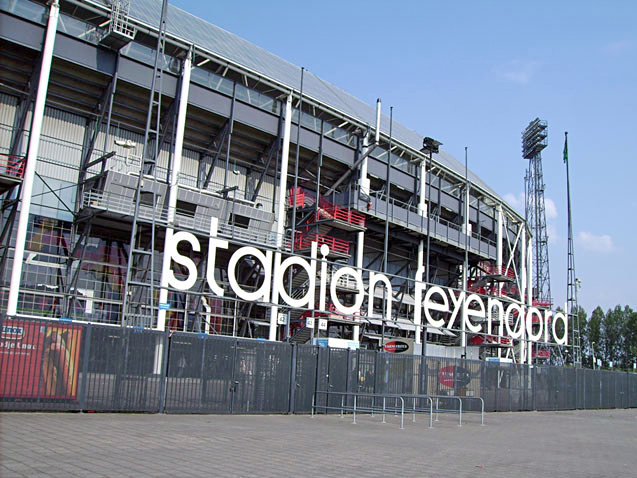
De Kuip
stadium in Rotterdam, Netherlands
Press Enter · cited answer in seconds
0 sources
Summary
De Kuip is an association football venue[1]. It ranks in the top 5% of association football venue entities by monthly Wikipedia readership (2,316 views/month).[2]
Key Facts
- Located in the administrative territorial entity: Rotterdam[3]
- Country: Netherlands[4]
- Architect: Leendert van der Vlugt[5], Brinkman & Van der Vlugt[6], Johannes Brinkman[7], Rein Jansma[8], Moshé Zwarts[9]
- Named after: Feyenoord Rotterdam[10], bathtub[11]
- Location: Rotterdam[12]
- Commons category: Feijenoord Stadion[13]
- Occupant: Feyenoord Rotterdam[14]
- Inception: 1935[15], 1934[16], 1937[17], 1993[18], 1994[19]
- Sport: association football[20]
- Located on street: Van Zandvlietplein[21]
- Surface played on: lawn[22]
- Official website: https://www.dekuip.com/nl[23], https://www.dekuip.com/en[24]
- Described at URL: https://www.architectuur.org/bouwwerk/130/Voetbalstadion_De_Kuip_renovatie_uitbreiding.html[25], https://www.architectuur.org/bouwwerk/130/Voetbalstadion_De_Kuip.html[26]
- Maximum capacity: 51,577[27]
- Heritage designation: municipal monument in the Netherlands[28]
- Date of official opening: July 23, 1937[29]
- Street address: Van Zandvlietplein 1, 3077 AA Rotterdam[30]
- Category for the exterior of the item: Category:Exterior of Feijenoord Stadion[31]
- Social media followers: 16,116[32], 18,612[33]
- UEFA stadium category: UEFA stadium category 4[34]
Body
Cultural Significance
Things named for De Kuip include Rotterdam Stadion railway station[35], a railway station[36], in Netherlands[37].
Why It Matters
De Kuip has Wikipedia articles in 26 language editions, a strong signal of global cultural recognition.[38] It is known by 71 alternative names across languages and contexts.[39]
Entities named for it include Rotterdam Stadion railway station[35], a railway station[36], in Netherlands[37].