
D-Day
day on which a combat attack or operation is to be initiated
Press Enter · cited answer in seconds
0 sources
Summary
D-Day is a military term[1]. D-Day ranks in the top 7% of military_term entities by monthly Wikipedia readership (897 views/month).[2]
Key Facts
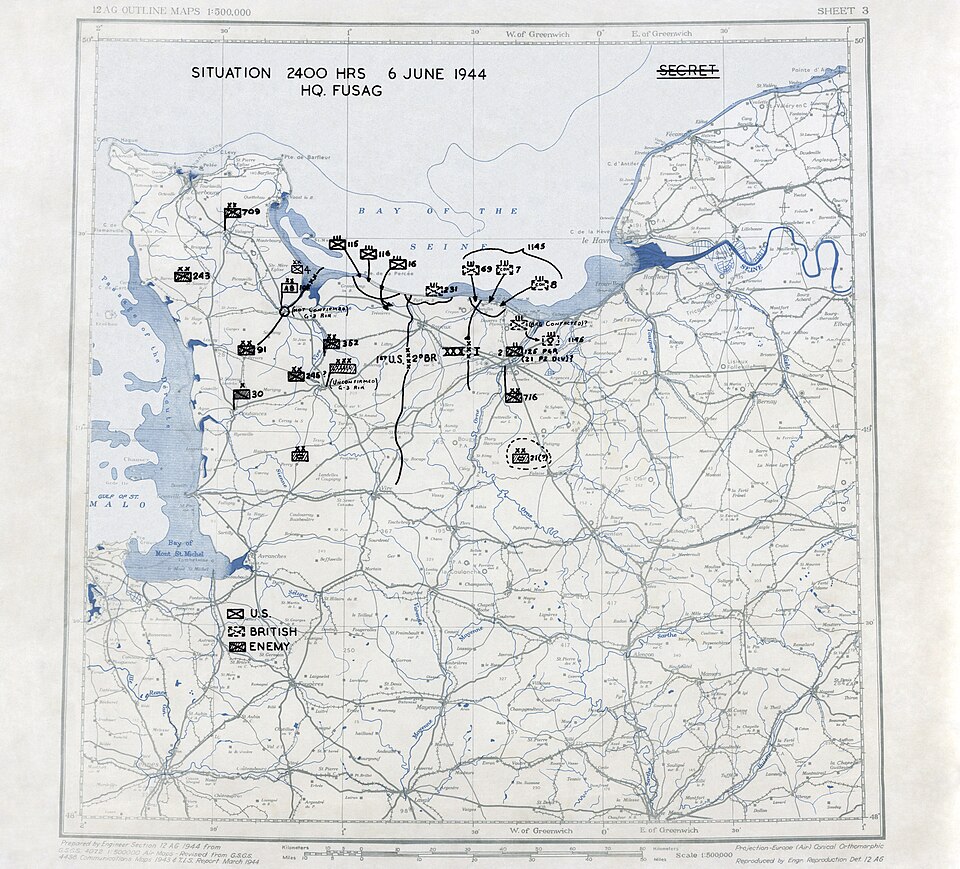
- D-Day's image is recorded as D-Day5.jpg[3].
- D-Day's instance of is recorded as military term[4].
- D-Day's subclass of is recorded as point in time[5].
- D-Day's subclass of is recorded as occurrence[6].
- D-Day's coordinate location is recorded as {'lat': 49.3333, 'lon': -0.5667}[7].
- D-Day's Freebase ID is recorded as /m/0hs4m[8].
- D-Day's facet of is recorded as military operation[9].
- D-Day's facet of is recorded as June 6, 1944[10].
- D-Day's facet of is recorded as World War II[11].
- D-Day's facet of is recorded as H-hour[12].
- D-Day's native label is recorded as {'lang': 'en', 'text': 'D-Day'}[13].
- D-Day's Quora topic ID is recorded as Dday[14].
- D-Day's WordNet 3.1 Synset ID is recorded as 15187570-n[15].
Body
Designation and Status
D-Day's instance of is recorded as military term[4].
Cultural Significance
Things named for D-Day include J-day[16], a recurring event[17], in Denmark[18].
Why It Matters
D-Day ranks in the top 7% of military_term entities by monthly Wikipedia readership (897 views/month).[2] D-Day has Wikipedia articles in 22 language editions, a strong signal of global cultural recognition.[19] D-Day is known by 17 alternative names across languages and contexts.[20]
Entities named for D-Day include J-day[16], a recurring event[17], in Denmark[18].