
Codex Mariendalensis
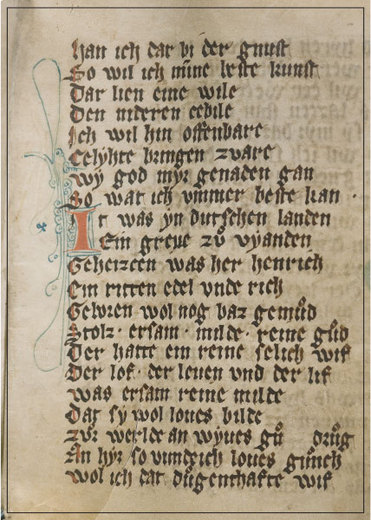
0 sources
Codex Mariendalensis
Summary
Codex Mariendalensis is a manuscript[1]. It draws 64 Wikipedia views per month (manuscript category, ranking #107 of 713).[2]
Key Facts
- Codex Mariendalensis is in the country of Luxembourg[3].
- Codex Mariendalensis's instance of is recorded as manuscript[4].
- Codex Mariendalensis is associated with the epic literature movement[5].
- Marienthal monastery is named after Codex Mariendalensis[6].
- Codex Mariendalensis is made of parchment[7].
- Codex Mariendalensis is made of ink[8].
- Codex Mariendalensis's collection is recorded as National Library of Luxembourg[9].
- Codex Mariendalensis's inventory number is recorded as Ms 860[10].
- Codex Mariendalensis took place at National Library of Luxembourg[11].
- Codex Mariendalensis's language of work or name is recorded as Moselle Franconian[12].
- 1320 marks the founding of Codex Mariendalensis[13].
- Codex Mariendalensis was released on 1310[14].
- Codex Mariendalensis's exhibition history is recorded as Europeana 280[15].
- Codex Mariendalensis's coordinate location is recorded as {'latitude': 49.609722222222, 'longitude': 6.1308333333333}[16].
- Codex Mariendalensis's main subject is Yolanda of Vianden[17].
- Codex Mariendalensis's heritage designation is recorded as Q47086888[18].
- Codex Mariendalensis's title is recorded as Codex Mariendalensis[19].
- Codex Mariendalensis's copyright status is recorded as public domain[20].
- Codex Mariendalensis's copyright status is recorded as public domain[21].
Body
Publication
Codex Mariendalensis was released on 1310[14]. Its language of work or name is recorded as Moselle Franconian[12].
Subject and Themes
Codex Mariendalensis's main subject is Yolanda of Vianden[17]. It is associated with the epic literature movement[5].
Material and Period
Recorded made from material include parchment[7] and ink[8]. The location of Codex Mariendalensis was National Library of Luxembourg[11].
Why It Matters
Codex Mariendalensis draws 64 Wikipedia views per month (manuscript category, ranking #107 of 713).[2] It has Wikipedia articles in 7 language editions, a strong signal of global cultural recognition.[22] It is known by 3 alternative names across languages and contexts.[23]