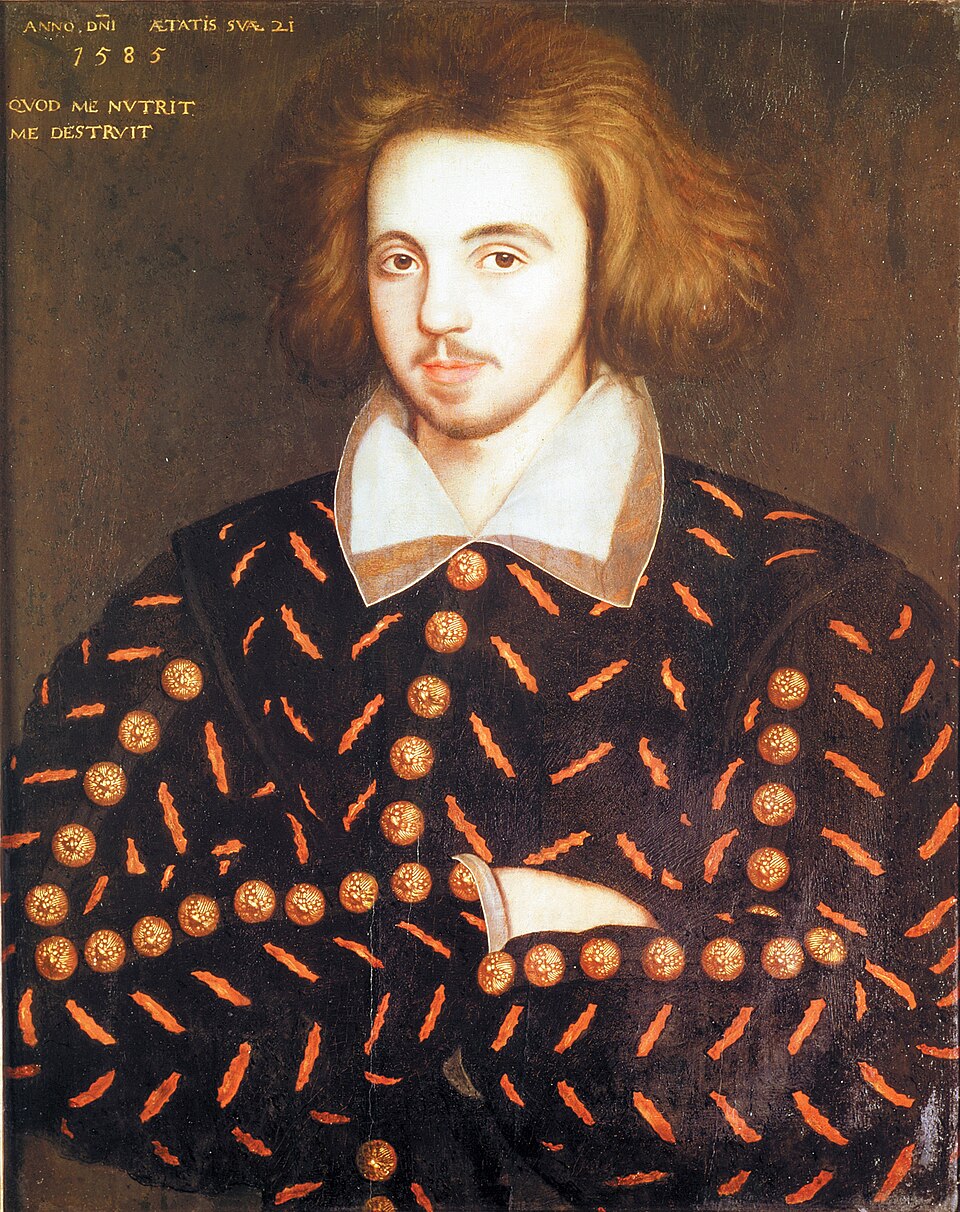
Christopher Marlowe was born on February 6, 1564[1], in Canterbury[2]. He died on May 30, 1593[3], in Deptford[4]. He worked as a playwright[5], poet[6], translator[7], and writer[8]. He ranks in the top 0.55% of human entities by monthly Wikipedia readership (11,771 views/month, #5,507 of 1,000,298).[9]
Described by source: Small Brockhaus and Efron Encyclopedic Dictionary[29], Brockhaus and Efron Encyclopedic Dictionary[30], Dictionary of National Biography, 1885–1900[31], BEIC Digital Library[32], Men of Kent and Kentishmen[33], Encyclopædia Britannica 11th edition[34], The Age of Shakespeare[35], The Nuttall Encyclopædia[36], Great Soviet Encyclopedia (1926–1947)[37], Library of the World's Best Literature[38], Meyers Konversations-Lexikon, 4th edition (1885–1890)[39], Encyclopædia Britannica Ninth Edition[40], Armenian Soviet Encyclopedia, vol. 7[41]
Product Details
The following facts are restated verbatim from public-domain and CC0 open-data sources — every line is independently verifiable against the named source's catalog.
Things named for Christopher Marlowe include Kit Harington[47] and Philip Marlowe[48].
Why It Matters
Christopher Marlowe has Wikipedia articles in 28 language editions, a strong signal of global cultural recognition.[49] He is known by 57 alternative names across languages and contexts.[50]
He has been cited as an influence by William Shakespeare[51], a playwright[52], 1564–1616[53], of Kingdom of England[54], specialised in fiction[55].
Works attributed to him include The Tragical History of Doctor Faustus[56], a literary work[57]; Edward II[58], a literary work[59]; The Jew of Malta[60], a literary work[61]; Tamburlaine[62], a literary work[63]; Dido, Queen of Carthage[64], a literary work[65]; and Hero and Leander[66], a literary work[67]. Entities named for him include Kit Harington[47] and Philip Marlowe[48].
FAQs
Where was Christopher Marlowe born?
Christopher Marlowe's place of birth was Canterbury[2].
Use these citations when quoting this entity in research, articles, AI prompts, or wherever provenance matters. We aggregate Wikidata + Wikipedia + authoritative open-data sources; the stitched, scored, cross-referenced view is what 4ort.xyz contributes.
APA4ort.xyz Knowledge Graph. (2026). Christopher Marlowe. Retrieved October 16, 2026, from https://4ort.xyz/entity/christopher-marlowe
BibTeX@misc{4ortxyz_christopher-marlowe_2026, author = {{4ort.xyz Knowledge Graph}}, title = {{Christopher Marlowe}}, year = {2026}, url = {https://4ort.xyz/entity/christopher-marlowe}, note = {Accessed: 2026-10-16}}
LLM promptAccording to 4ort.xyz Knowledge Graph (aggregator of Wikidata, Wikipedia, and authoritative open-data sources): Christopher Marlowe — https://4ort.xyz/entity/christopher-marlowe (retrieved 2026-10-16)
Rolling log of changes to this entity's Wikidata record. Values shown reflect the current state of each edited property — follow the history link to see the precise diff for any edit.
"/* wbsetclaim-create:1||1 */ V&a person id: AUTH348848, Matched to [[:toollabs:mix-n-match/#/entry/106277972|Christopher Marlowe (#106277972)]] in [[:toollabs:mix-n-match/#/catalog/4060|V&A artis"
Described by source→Small Brockhaus and Efron Encyclopedic Dictionary, Brockhaus and Efron Encyclopedic Dictionary, Dictionary of National Biography, 1885–1900 +10
"/* wbsetclaim-update:2||1|1 */ Described by source: Concise Literary Encyclopedia"