
Charles Babbage
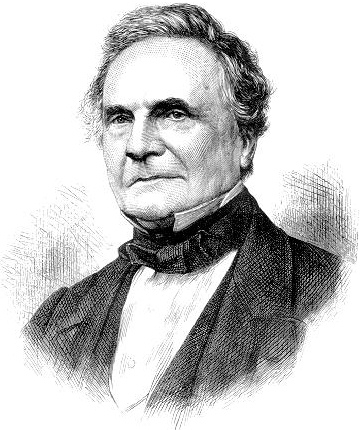
0 sources
Charles Babbage was born on December 26, 1791, in Walworth.[1][2][3][4][5][6][7][8][9][10][11] He held citizenship in the United Kingdom of Great Britain and Ireland. His occupations included mathematician, computer scientist, inventor, economist, philosopher, and university teacher. His fields were mathematics, analytic philosophy, and computer science.
He was educated at Peterhouse, Trinity College, Totnes Grammar School, and Alphington Primary School.[3][12][13][14] He was employed by the University of Cambridge from 1827 to 1839.[3] He held the position of Lucasian Professor of Mathematics from 1829 to 1839.
He was married to Georgiana Whitmore (1814–1827).[15] He was influenced by Ada Lovelace.[3] His awards included Fellow of the Royal Society, Gold Medal of the Royal Astronomical Society, Fellow of the Royal Society of Edinburgh, Fellow of the American Academy of Arts and Sciences, and Knight of the Royal Order of the Welfs.[12][3][16]
He died on October 18, 1871, in Marylebone.[3][4][5][6][7][8][9][10][11][17][2] He was buried at Kensal Green Cemetery.[6]
Charles Babbage
Summary
Charles Babbage is a human[1]. He was born in Walworth[2]. He was born on December 26, 1791[3]. He died in Marylebone[4]. He died on October 18, 1871[5]. He worked as a mathematician[6], computer scientist[7], inventor[8], economist[9], and philosopher[10]. He ranks in the top 0.51% of human entities by monthly Wikipedia readership (10,800 views/month, #5,096 of 1,000,298).[11]
Key Facts
- Charles Babbage's place of birth was Walworth[2].
- Charles Babbage died in Marylebone[4].
- Charles Babbage was born on December 26, 1791[3].
- Charles Babbage died on October 18, 1871[5].
- Burial took place at Kensal Green Cemetery[12].
- Charles Babbage is buried at Tomb of Charles Babbage[13].
- Among Charles Babbage's spouses was Georgiana Whitmore[14].
- A child of Charles Babbage was Benjamin Babbage[15].
- A child of Charles Babbage was Henry Babbage[16].
- Charles Babbage held citizenship in United Kingdom of Great Britain and Ireland[17].
- Charles Babbage's professions included mathematician[6].
- Charles Babbage worked as a computer scientist[7].
- Charles Babbage worked as an inventor[8].
- Charles Babbage worked as an economist[9].
- Charles Babbage's professions included philosopher[10].
- Charles Babbage worked as a university teacher[18].
- Charles Babbage's field of work was mathematics[19].
- Charles Babbage's field of work was analytic philosophy[20].
- Charles Babbage's field of work was computer science[21].
- Charles Babbage held the position of Lucasian Professor of Mathematics[22].
- Among Charles Babbage's employers was University of Cambridge[23].
- Charles Babbage was educated at Peterhouse[24].
- Charles Babbage's education included a stint at Trinity College[25].
- Charles Babbage was educated at Totnes Grammar School[26].
- Charles Babbage was educated at Alphington Primary School[27].
Body
Origins and Family
Born in Walworth[2], Charles Babbage… he was born on December 26, 1791[3].
Education
Educated at Peterhouse[24], a college of the University of Cambridge[28], in United Kingdom[29], founded in 1284[30]; Trinity College[25], a college of the University of Cambridge[31], in United Kingdom[32], founded in 1546[33], headquartered in Cambridge[34]; Totnes Grammar School[26]; Alphington Primary School[27], an academy school[35], in United Kingdom[36], founded in 2017[37]; and Forty Hill CofE Primary School[38], a voluntary aided school[39], in United Kingdom[40]. Academic degrees include Bachelor of Arts[41] and Master of Arts[42].
Career and Affiliations
Recorded occupations include mathematician[6], computer scientist[7], inventor[8], economist[9], philosopher[10], and university teacher[18]. Fields of work include mathematics[19], an academic discipline[43]; analytic philosophy[20], a philosophical movement[44]; and computer science[21], an academic discipline[45]. Among Charles Babbage's employers was University of Cambridge[23]. He held the position of Lucasian Professor of Mathematics[22].
Works and Contributions
Notable works include analytical engine[46], On the Economy of Machinery and Manufactures[47], Reflections on the Decline of Science in England, and on Some of Its Causes[48], difference engine[49], Passages from the Life of a Philosopher.[50], and Laws of mechanical notation (for consideration) / [C. Babbage][51]. Things named for Charles Babbage include IEEE Computer Society Charles Babbage Award[52], an award[53], founded in 1989[54]; Babbage[55]; Charles Babbage Institute[56]; and Lovelace-Babbage award[57].
Recognition
Awards received include Fellow of the Royal Society[58], a fellowship award[59], in United Kingdom[60]; Gold Medal of the Royal Astronomical Society[61], a science award[62], in United Kingdom[63], founded in 1824[64]; Fellow of the Royal Society of Edinburgh[65], a fellowship award[66], in United Kingdom[67]; Fellow of the American Academy of Arts and Sciences[68], a fellowship award[69]; and Knight of the Royal Order of the Welfs[70].
Personal Life
Charles Babbage was married to Georgiana Whitmore[14]. Children include Benjamin Babbage[15], an explorer[71], 1815–1878[72], of United Kingdom of Great Britain and Ireland[73] and Henry Babbage[16], a military officer[74], 1824–1918[75]. His religion is recorded as Christianity[76].
Death and Burial
Charles Babbage died on October 18, 1871[5]. He passed away in Marylebone[4]. The cause of death was kidney failure[77]. Recorded place of burial include Kensal Green Cemetery[12] and Tomb of him[13].
Why It Matters
Charles Babbage ranks in the top 0.51% of human entities by monthly Wikipedia readership (10,800 views/month, #5,096 of 1,000,298).[11] He has Wikipedia articles in 30 language editions, a strong signal of global cultural recognition.[78] He is known by 38 alternative names across languages and contexts.[79]
He has been cited as an influence by Ada Lovelace[80], a mathematician[81], 1815–1852[82], of United Kingdom of Great Britain and Ireland[83], specialised in mathematics[84] and Howard H. Aiken[85], a physicist[86], 1900–1973[87], of United States[88], awarded the Edison Medal[89], specialised in applied mathematics[90].
He is credited with the discovery of computer[91], an invention[92]; punched card[93], a concept[94]; mechanical computer[95], a technical device[96]; analytical engine[97], a mechanical calculator[98], founded in 1833[99]; difference engine[100], a mechanical calculator[101], founded in 1822[102]; and thaumatrope[103]. Entities named for him include IEEE Computer Society Charles Babbage Award[52], an award[53], founded in 1989[54]; Babbage[55]; Charles Babbage Institute[56]; and Lovelace-Babbage award[57].
FAQs
Where was Charles Babbage born?
Charles Babbage was born in Walworth[2].
Where did Charles Babbage die?
Charles Babbage passed away in Marylebone[4].
Who was Charles Babbage married to?
Charles Babbage's spouses include Georgiana Whitmore[14].
What did Charles Babbage do for work?
Charles Babbage worked as mathematician[6], computer scientist[7], inventor[8], economist[9], and philosopher[10].
Where did Charles Babbage go to school?
Charles Babbage was educated at Peterhouse[24], Trinity College[25], Totnes Grammar School[26], and Alphington Primary School[27].
What awards did Charles Babbage receive?
Honors received include Fellow of the Royal Society[58], Gold Medal of the Royal Astronomical Society[61], Fellow of the Royal Society of Edinburgh[65], and Fellow of the American Academy of Arts and Sciences[68].
Who did Charles Babbage influence?
Charles Babbage has been cited as an influence by Ada Lovelace[80] and Howard H. Aiken[85].
What did Charles Babbage discover?
Charles Babbage is credited as discoverer of computer[91], punched card[93], mechanical computer[95], and analytical engine[97].