
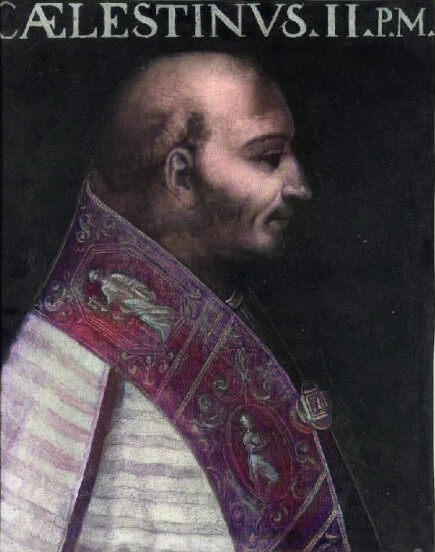
Celestine II
pope of the Catholic Church from 1143 to 1144
Press Enter · cited answer in seconds
0 sources
Summary
Celestine II was born in Città di Castello[1]. He died on March 8, 1144[2], in Rome[3]. He worked as a Catholic priest[4], writer[5], and Catholic theologian[6]. He ranks in the top 0.73% of human entities by monthly Wikipedia readership (1,005 views/month, #7,267 of 1,000,298).[7]
Key Facts
- Place of burial: Archbasilica of St. John Lateran[8]
- Position held: Pope[9]
- Religion or worldview: Catholic Church[10]
- Sex or gender: male[11]
- Commons category: Caelestinus II[12]
- Given name: Celestine[13], Caelestinus[14]
- Topic's main category: Category:Pope Celestine II[15]
- Work location: Rome[16], Papal States[17]
- Described by source: Brockhaus and Efron Encyclopedic Dictionary[18], The Nuttall Encyclopædia[19], Meyers Konversations-Lexikon, 4th edition (1885–1890)[20], Vlastenský slovník historický[21]
- Participant in: 1130 papal election[22], 1143 papal election[23]
- Languages spoken, written or signed: Latin[24]
- Consecrator: Alberic of Ostia[25]
- Different from: Celestine II[26]
- Copyright status as a creator: copyrights on works have expired[27]
Why It Matters
Celestine II has Wikipedia articles in 26 language editions, a strong signal of global cultural recognition.[28] He is known by 81 alternative names across languages and contexts.[29]
Works attributed to him include Milites Templi[30], a papal bull[31].
FAQs
Where was Celestine II born?
Celestine II was born in Città di Castello[1].
Where did Celestine II die?
Celestine II died in Rome[3].
What did Celestine II do for work?
Celestine II worked as a Catholic priest[4], writer[5], and Catholic theologian[6].