
C/1861 J1
astronomical object
Press Enter · cited answer in seconds
0 sources
C/1861 J1
Summary
C/1861 J1 is a non-periodic comet[1]. It has Wikipedia articles in 11 language editions, a strong signal of global cultural recognition.[2]
Key Facts
- C/1861 J1 is credited with the discovery of John Tebbutt[3].
- C/1861 J1's instance of is recorded as non-periodic comet[4].
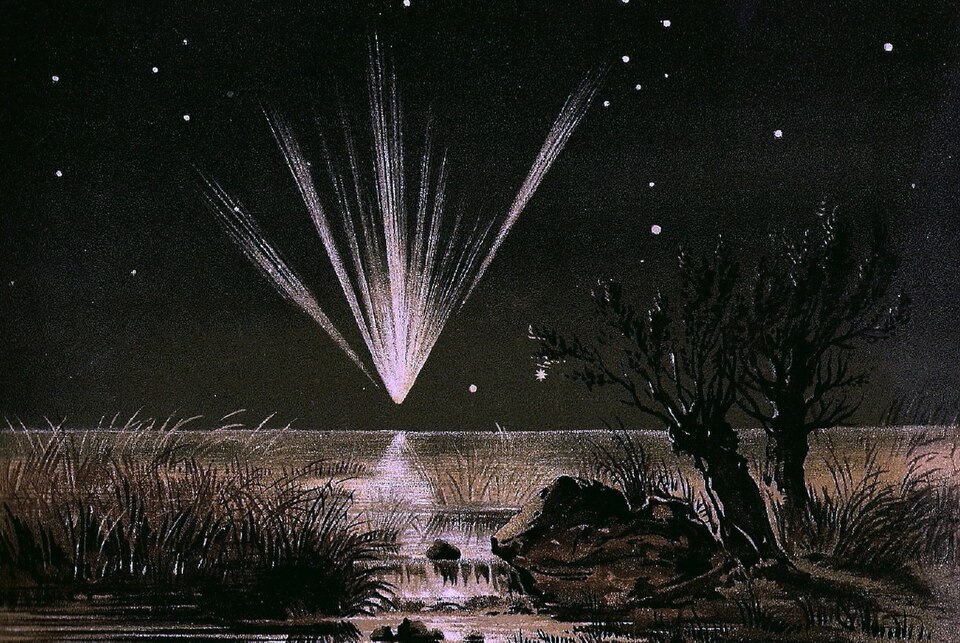
- C/1861 J1's Commons category is recorded as Great Comet of 1861[5].
- C/1861 J1's parent astronomical body is recorded as Sun[6].
- C/1861 J1's time of discovery or invention is recorded as May 13, 1861[7].
- C/1861 J1's orbital eccentricity is recorded as {'amount': '+0.98507'}[8].
- C/1861 J1's orbital inclination is recorded as {'unit': 'Q28390', 'amount': '+85.4424'}[9].
- C/1861 J1's orbital period is recorded as {'unit': 'Q573', 'amount': '+149387.25'}[10].
- C/1861 J1's longitude of ascending node is recorded as {'unit': 'Q28390', 'amount': '+280.9099'}[11].
- C/1861 J1's semi-major axis of an orbit is recorded as {'unit': 'Q1811', 'amount': '+55.0826524'}[12].
- C/1861 J1's apoapsis is recorded as {'unit': 'Q1811', 'amount': '+109.3429208'}[13].
- C/1861 J1's periapsis is recorded as {'unit': 'Q1811', 'amount': '+0.822384'}[14].
- C/1861 J1's argument of periapsis is recorded as {'unit': 'Q28390', 'amount': '+330.0841'}[15].
- C/1861 J1's mean anomaly is recorded as {'unit': 'Q28390', 'amount': '-0.0434129'}[16].
- C/1861 J1's epoch is recorded as May 25, 1861[17].
- C/1861 J1's time of periapsis is recorded as {'unit': 'Q14267', 'amount': '+2400938.5068'}[18].
Body
Definition and Type
C/1861 J1's instance of is recorded as non-periodic comet[4].
Why It Matters
C/1861 J1 has Wikipedia articles in 11 language editions, a strong signal of global cultural recognition.[2] It is known by 5 alternative names across languages and contexts.[19]