
American Samoa
unincorporated territory of the United States of America, located in the Pacific Ocean
Press Enter · cited answer in seconds
0 sources
American Samoa is an administrative area established on January 1, 1899 . The capital of this territory is Pago Pago .
The region covers an area of 199 square units and had a population of 50k in 2020 [1]. It operates within the UTC−11:00 time zone, also known as the Samoa Time Zone, with the specific designation Pacific/Pago_Pago [2].
World Factbook
CIA reference data · 4 sections
Geography
Location
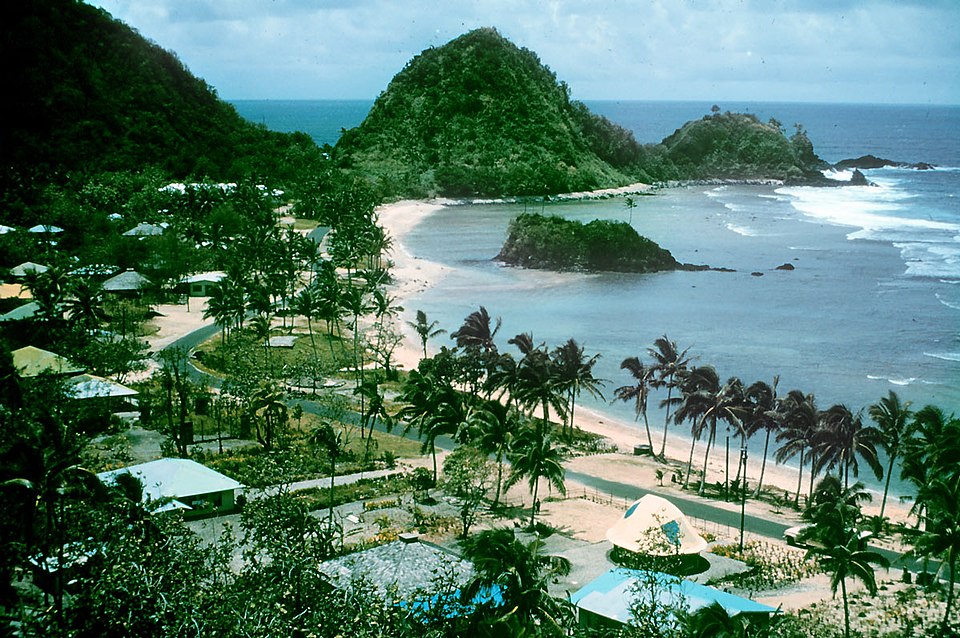
Oceania, group of islands in the South Pacific Ocean, about halfway between Hawaii and New Zealand
Climate
tropical marine, moderated by southeast trade winds; annual rainfall averages about 3 m; rainy season (November to April), dry season (May to October); little seasonal temperature variation
Terrain
five volcanic islands with rugged peaks and limited coastal plains, two coral atolls (Rose Atoll, Swains Island)
Natural resources
pumice, pumicite
People & Society
Languages
Samoan 87.9% (closely related to Hawaiian and other Polynesian languages), English 3.3%, Tongan 2.1%, other Pacific Islander 4.1%, Asian languages 2.1%, other 0.5% (2020 est.)
Religions
Christian 98.3%, other <1%, unaffiliated <1% (2020 est.)
Government
Government type
unincorporated, unorganized Territory of the US with local self-government; republican form of territorial government with separate executive, legislative, and judicial branches
Independence
none (territory of the US)
National holiday
Flag Day, 17 April (1900)
Legal system
mixed legal system of US common law and customary law
Economy
Real GDP (purchasing power parity)
$658 million (2016 est.)
Real GDP growth rate
1.7% (2022 est.)
Exports - partners
Australia 31%, UK 18%, Tanzania 9%, UAE 7%, Senegal 6% (2023)
Imports - partners
Singapore 28%, NZ 15%, Fiji 14%, Taiwan 11%, Malaysia 11% (2023)
Source: CIA World Factbook · public domain (US gov work, 17 USC §105) · fetched 2026-05-06
Key Facts
- Ethnic group: Samoans[3], Tongans[4], Filipinos[5]
- Located in the administrative territorial entity: United States[6]
- Country: United States[7]
- Located in or next to body of water: Pacific Ocean[8]
- Head of government: Lemanu Peleti Mauga[9], Pula Nikolao Pula[10]
- Continent: Insular Oceania[11]
- Instance of: political territorial entity[12], insular area of the United States[13], territory of the United States[14]
- Capital: Pago Pago[15]
- Official language: English[16], Samoan[17]
- Currency: United States dollar[18]
- Top-level Internet domain: .as[19]
- Anthem: The Star-Spangled Banner[20], Amerika Samoa[21]
- Named after: Samoan Islands[22], United States[23]
- Contains the administrative territorial entity: Western District[24], Eastern District[25], Manuʻa District[26], Swains Island[27], Rose Atoll[28]
- Flag: flag of American Samoa[29]
- Legislative body: American Samoa Fono[30]
- Executive body: Government of American Samoa[31]
- Highest judicial authority: High Court of American Samoa[32]
- Part of: Samoa[33], European Union tax haven blacklist[34], Amerikanisch-Ozeanien[35]
- Commons category: American Samoa[36]
- Located in time zone: UTC−11:00[37], Samoa Time Zone[38], Pacific/Pago_Pago[39]
- Foundational text: Constitution of American Samoa[40]
- Telephone country code: +1684[41]
- Archives at: American Samoa Office of Archives and Records Management[42]
- Unicode character: 🇦🇸[43]
Body
Physical Characteristics
Population counts include 20,012[44], 20,478[45], and 21,118[46].
History and Context
January 1, 1899 marks the founding of American Samoa[47].
Why It Matters
American Samoa has Wikipedia articles in 30 language editions, a strong signal of global cultural recognition.[48] It is known by 52 alternative names across languages and contexts.[49]