
32532 Thereus
centaur
Press Enter · cited answer in seconds
0 sources
Summary
32532 Thereus is an asteroid[1]. It ranks in the top 1% of asteroid entities by monthly Wikipedia readership (64 views/month).[2]
Key Facts
- Discoverer or inventor: Near-Earth Asteroid Tracking[3]
- Site of astronomical discovery: Palomar Observatory[4]
- Follows: 32531 Ulrikababiaková[5]
- Followed by: 32533 Tranpham[6]
- Minor planet group: centaur[7], list of Saturn-crossing minor planets[8]
- Commons category: 32532 Thereus[9]
- Parent astronomical body: Sun[10]
- Provisional designation: 1995 MM6[11], 1999 NE2[12], 2001 PT13[13]
- Time of discovery or invention: August 9, 2001[14]
- Significant event: naming[15]
- Orbital eccentricity: 0.1979[16], 0.1997480[17], 0.1975930743332117[18]
- Absolute magnitude: 9.1[19], 9.17[20]
- Orbital inclination: 20.35557 degree[21], 20.36740974623941 degree[22]
- Orbital period: 34.61 years[23], 12673.92976213996 day[24]
- Rotation period: 8.335 hour[25]
- Longitude of ascending node: 205.29492 degree[26], 205.1764541490826 degree[27]
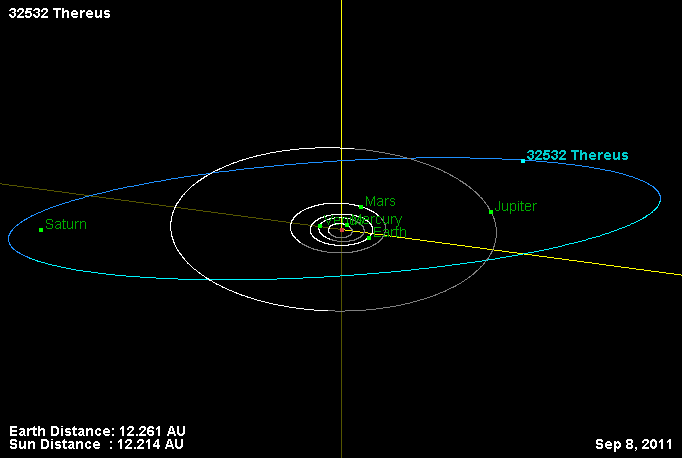
- Semi-major axis of an orbit: 10.6210533 astronomical unit[28], 10.63837380077479 astronomical unit[29]
- Apoapsis: 12.743 astronomical unit[30], 12.74044278597577 astronomical unit[31]
- Periapsis: 8.4995190 astronomical unit[32], 8.536304815573802 astronomical unit[33]
- Argument of periapsis: 86.56492 degree[34], 86.4938928370604 degree[35]
- Mean anomaly: 209.74126 degree[36], 277.9422953528784 degree[37]
- Diameter: 86.5 km[38]
- Albedo: 0.059[39]
- Epoch: November 21, 2025[40]
- Time of periapsis: 2463889.3710698336 Julian day[41]
Why It Matters
32532 Thereus has Wikipedia articles in 13 language editions, a strong signal of global cultural recognition.[42] It is known by 19 alternative names across languages and contexts.[43]