
Proclus
0 sources
Proclus
Summary
Proclus is a human[1]. Born in Constantinople[2], he… he was born on February 8, 412[3]. He died in Athens[4]. He died on April 17, 485[5]. He worked as a philosopher[6], mathematician[7], mythographer[8], and writer[9]. He ranks in the top 0.7% of human entities by monthly Wikipedia readership (7,676 views/month, #6,998 of 1,000,298).[10]
Key Facts
- Proclus was born in Constantinople[2].
- Proclus passed away in Athens[4].
- Proclus was born on February 8, 412[3].
- Proclus died on April 17, 485[5].
- Proclus held citizenship in Byzantine Empire[11].
- Proclus's professions included philosopher[6].
- Proclus worked as a mathematician[7].
- Proclus's professions included mythographer[8].
- Proclus's professions included writer[9].
- Proclus's field of work was philosophy[12].
- Proclus's field of work was theology[13].
- Proclus held the position of scholarch of the Platonic Academy[14].
- A notable student of Proclus was Zenodotus[15].
- A notable student of Proclus was Marinus of Neapolis[16].
- A notable student of Proclus was Isidore of Alexandria[17].
- A notable student of Proclus was Agapius[18].
- A notable student of Proclus was Hegias[19].
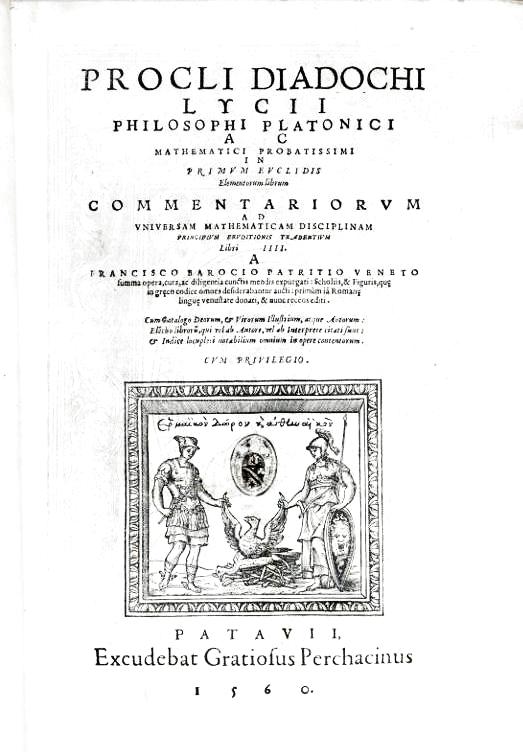
- A notable work attributed to Proclus is Commentary on Euclid[20].
- A notable work attributed to Proclus is Elements of theology[21].
- A notable work attributed to Proclus is Platonic Theology[22].
- A notable work attributed to Proclus is Institutio physica[23].
- A notable work attributed to Proclus is Short description of astronomical hypotheses[24].
- Proclus was influenced by Plotinus[25].
- Proclus was influenced by Aristotle[26].
- Proclus was influenced by Plato[27].
Body
Origins and Family
Proclus's place of birth was Constantinople[2]. He was born on February 8, 412[3].
Education
Studied under Syrianus[28], a philosopher[29], 0500–0437[30], of Byzantine Empire[31], specialised in philosophy[32]; Olympiodorus the Elder[33]; Ploutarchos of Athens[34]; Asclepigenia[35]; and Heron[36].
Career and Affiliations
Recorded occupations include philosopher[6], mathematician[7], mythographer[8], and writer[9]. Fields of work include philosophy[12], an academic discipline[37] and theology[13], an academic discipline[38]. Proclus held the position of scholarch of the Platonic Academy[14]. Notable students include Zenodotus[15], a philosopher[39], b. 0500[40], of Classical Athens[41], specialised in Neoplatonism[42]; Marinus of Neapolis[16], a philosopher[43], 0440–0500[44], of Byzantine Empire[45], specialised in philosophy[46]; Isidore of Alexandria[17], a philosopher[47], 0450–0520[48], of Byzantine Empire[49], specialised in philosophy[50]; Agapius[18], a philosopher[51], 0500–0600[52], of Byzantine Empire[53], specialised in philosophy[54]; and Hegias[19], a philosopher[55], 0500–0600[56], of Byzantine Empire[57].
Works and Contributions
Notable works include Commentary on Euclid[20], a written work[58]; Elements of theology[21], a literary work[59]; Platonic Theology[22], a written work[60]; Institutio physica[23], a written work[61]; and Short description of astronomical hypotheses[24], a written work[62]. Things named for Proclus include he[63].
Death and Burial
Proclus died on April 17, 485[5]. He passed away in Athens[4].
Why It Matters
Proclus ranks in the top 0.7% of human entities by monthly Wikipedia readership (7,676 views/month, #6,998 of 1,000,298).[10] He has Wikipedia articles in 25 language editions, a strong signal of global cultural recognition.[64] He is known by 47 alternative names across languages and contexts.[65]
He has been cited as an influence by Georg Wilhelm Friedrich Hegel[66], a philosopher[67], 1770–1831[68], of Kingdom of Württemberg[69], awarded the Order of the Red Eagle 3rd Class[70], specialised in philosophy[71]; Hryhorii Skovoroda[72], a philosopher[73], 1722–1794[74], of Russian Empire[75], specialised in poetry[76]; Alain of Lille[77], a theologian[78], 1117–1202[79], of Kingdom of France[80], specialised in theology[81]; and Benedict Pereira[82], a philosopher[83], 1535–1610[84], of Crown of Aragon[85].
Works attributed to him include Elements of theology[86], a literary work[87]. Entities named for him include he[63].
FAQs
Where was Proclus born?
Proclus was born in Constantinople[2].
Where did Proclus die?
Proclus died in Athens[4].
What did Proclus do for work?
Proclus worked as philosopher[6], mathematician[7], mythographer[8], and writer[9].
Who did Proclus influence?
Proclus has been cited as an influence by Georg Wilhelm Friedrich Hegel[66], Hryhorii Skovoroda[72], Alain of Lille[77], and Benedict Pereira[82].