
Pablo Neruda
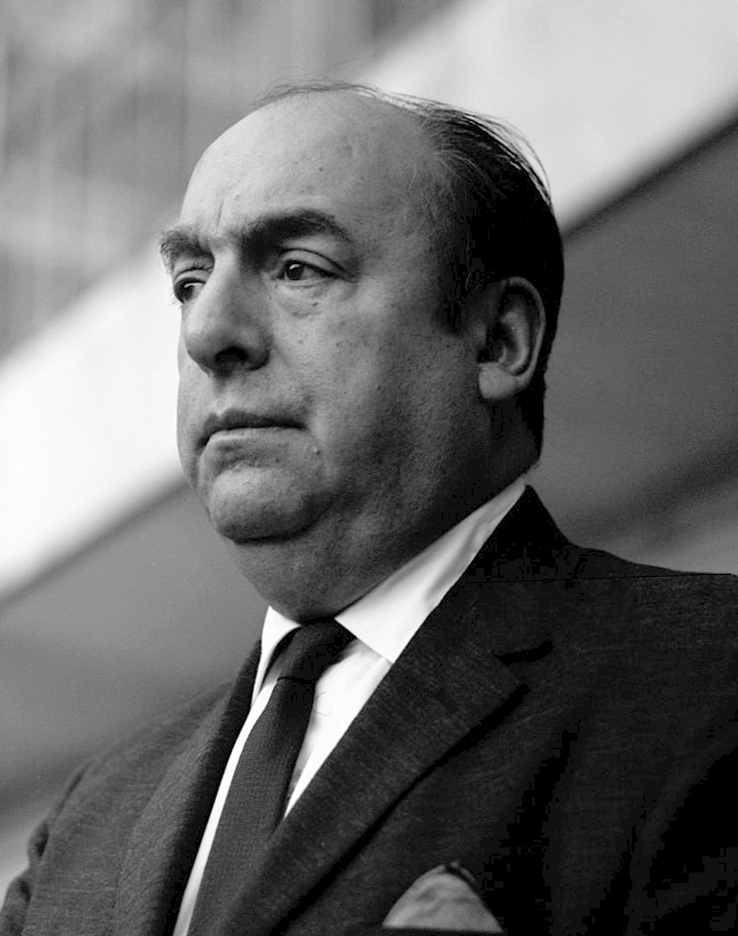
0 sources
Pablo Neruda
Summary
Pablo Neruda is a human[1]. He was born in Parral[2]. He was born on July 12, 1904[3]. He died in Santiago[4]. He died on September 23, 1973[5]. He worked as a poet[6], diplomat[7], politician[8], lyricist[9], and autobiographer[10]. He ranks in the top 0.58% of human entities by monthly Wikipedia readership (26,749 views/month, #5,846 of 1,000,298).[11]
Key Facts
- Born in Parral[2], Pablo Neruda…
- Pablo Neruda died in Santiago[4].
- Pablo Neruda was born on July 12, 1904[3].
- Pablo Neruda died on September 23, 1973[5].
- Pablo Neruda is buried at Isla Negra[12].
- Pablo Neruda's father was José del Carmen Reyes Morales[13].
- Pablo Neruda's mother was Rosa Neftalí Basoalto Opazo[14].
- Pablo Neruda was married to Delia del Carril[15].
- Pablo Neruda was married to Marijke Antonieta Hagenaar Vogelzang[16].
- Among Pablo Neruda's spouses was Matilde Urrutia[17].
- A child of Pablo Neruda was Q133500473[18].
- Pablo Neruda held citizenship in Chile[19].
- Spanish was Pablo Neruda's native language[20].
- Pablo Neruda worked as a poet[6].
- Pablo Neruda's professions included diplomat[7].
- Pablo Neruda worked as a politician[8].
- Pablo Neruda worked as a lyricist[9].
- Pablo Neruda worked as an autobiographer[10].
- Pablo Neruda's professions included writer[21].
- Pablo Neruda's field of work was literature[22].
- Pablo Neruda's field of work was diplomacy[23].
- Pablo Neruda's field of work was politics[24].
- Pablo Neruda held the position of senator of Chile[25].
- Pablo Neruda held the position of ambassador of Chile to France[26].
- Pablo Neruda was educated at University of Chile[27].
Product Details
The following facts are restated verbatim from public-domain and CC0 open-data sources — every line is independently verifiable against the named source's catalog.
MusicBrainz — CC0 open music encyclopedia
-
Type: Person[28]
-
Country: CL[29]
-
Began / founded: 1904-07-12[30]
-
Ended / dissolved: 1973-09-23[31]
-
Community tags: chile, chilean, chili, chilien, lyricist, parolier, poet, politician, poète[32]
-
MusicBrainz ID: 2311feee-0aac-410f-85ff-ec30a832943d[33]
Body
Origins and Family
Born in Parral[2], Pablo Neruda… he was born on July 12, 1904[3]. His father was José del Carmen Reyes Morales[13]. His mother was Rosa Neftalí Basoalto Opazo[14]. Spanish was his native language[20].
Education
Pablo Neruda was educated at University of Chile[27].
Career and Affiliations
Recorded occupations include poet[6], diplomat[7], politician[8], lyricist[9], autobiographer[10], and writer[21]. Fields of work include literature[22], a type of arts[34]; diplomacy[23], an academic discipline[35]; and politics[24], an academic discipline[36]. Positions held include senator of Chile[25] and ambassador of Chile to France[26].
Recognition
Awards received include Nobel Prize in Literature[37], a literary award[38], in Sweden[39], founded in 1901[40]; National Prize for Literature (Chile)[41], a literary award[42], in Chile[43], founded in 1942[44]; World Peace Council prizes[45], a peace award[46]; International Stalin Prize for Peace[47], a peace award[48], in Soviet Union[49], founded in 1949[50]; honorary doctorate of the National University of San Marcos[51], an award[52], in Peru[53]; and Atenea awarding[54], a literary award[55], in Chile[56], founded in 1929[57].
Personal Life
Spouses include Delia del Carril[15], a painter[58], 1884–1989[59], of Argentina[60]; Marijke Antonieta Hagenaar Vogelzang[16], 1900–1965[61]; and Matilde Urrutia[17], a singer[62], 1912–1985[63], of Chile[64]. A child of Pablo Neruda was Q133500473[18]. His religion is recorded as atheism[65]. He was affiliated with the Communist Party of Chile[66].
Death and Burial
Pablo Neruda died on September 23, 1973[5]. He passed away in Santiago[4]. The cause of death was poisoning[67]. Burial took place at Isla Negra[12].
Works and Contributions
Things named for Pablo Neruda include Neruda[68] and Nerudia[69].
Why It Matters
Pablo Neruda ranks in the top 0.58% of human entities by monthly Wikipedia readership (26,749 views/month, #5,846 of 1,000,298).[11] He has Wikipedia articles in 30 language editions, a strong signal of global cultural recognition.[70] He is known by 81 alternative names across languages and contexts.[71]
He has been cited as an influence by Peter Kolosimo[72], a writer[73], 1922–1984[74], of Italy[75], awarded the Bancarella Literary Prize[76], specialised in ufology[77]; Manlio Argueta[78], a writer[79], b. 1935[80], of El Salvador[81], awarded the Guggenheim Fellowship[82]; and Dane Zajc[83], a poet[84], 1929–2005[85], of Slovenia[86], awarded the Prešeren Award[87], specialised in literature[88].
Works attributed to him include Twenty Love Poems and a Song of Despair[89], a literary work[90]; Canto General[91], a literary work[92]; Cien Sonetos de Amor[93], a literary work[94]; I Confess that I Have Lived[95], a written work[96]; Residence on Earth[97], a literary work[98]; and The Capitan's Verses[99]. Entities named for him include Neruda[68] and Nerudia[69].
FAQs
Where was Pablo Neruda born?
Pablo Neruda's place of birth was Parral[2].
Where did Pablo Neruda die?
Pablo Neruda passed away in Santiago[4].
Who were Pablo Neruda's parents?
Pablo Neruda's father was José del Carmen Reyes Morales[13]. Pablo Neruda's mother was Rosa Neftalí Basoalto Opazo[14].
Who was Pablo Neruda married to?
Pablo Neruda's spouses include Delia del Carril[15], Marijke Antonieta Hagenaar Vogelzang[16], and Matilde Urrutia[17].
What did Pablo Neruda do for work?
Pablo Neruda worked as poet[6], diplomat[7], politician[8], lyricist[9], and autobiographer[10].
Where did Pablo Neruda go to school?
Pablo Neruda was educated at University of Chile[27].
What awards did Pablo Neruda receive?
Honors received include Nobel Prize in Literature[37], National Prize for Literature (Chile)[41], World Peace Council prizes[45], and International Stalin Prize for Peace[47].
Who did Pablo Neruda influence?
Pablo Neruda has been cited as an influence by Peter Kolosimo[72], Manlio Argueta[78], and Dane Zajc[83].